


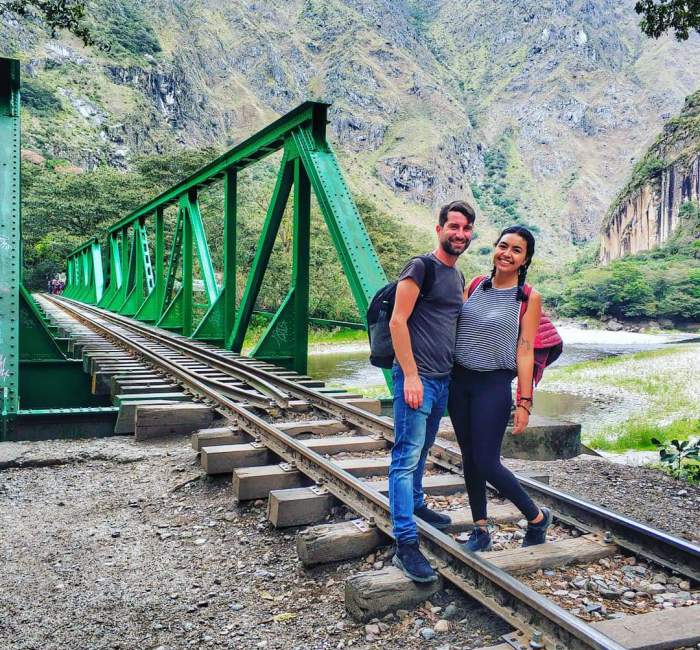
You arrive at Hidroeléctrica station after four days of trekking, with the afternoon sun over the jungle and a decision ahead. On one side, a group is getting ready to walk the remaining ten kilometers to Aguas Calientes. On the other, a few travelers wait for the train that covers the same stretch in a fraction of the time. This is where the road ends, and there are no options beyond these two. Which one suits you depends on how you arrive, how much luggage you are carrying, and what time it is.
Why the road ends here
Hidroeléctrica gets its name from the power plant that uses water from the Urubamba River to generate electricity. It is the closest point to Machu Picchu that vehicles can reach from the Santa Teresa side.
From here onward, the canyon narrows and only the railway passes through. Aguas Calientes, the town at the foot of the sanctuary, has no road access from any direction. That is why everyone arriving by this route ends up choosing between the tracks and the train.
Walking along the railway
This is what most trek groups do, and many tours include it in the itinerary.
What the trail is like
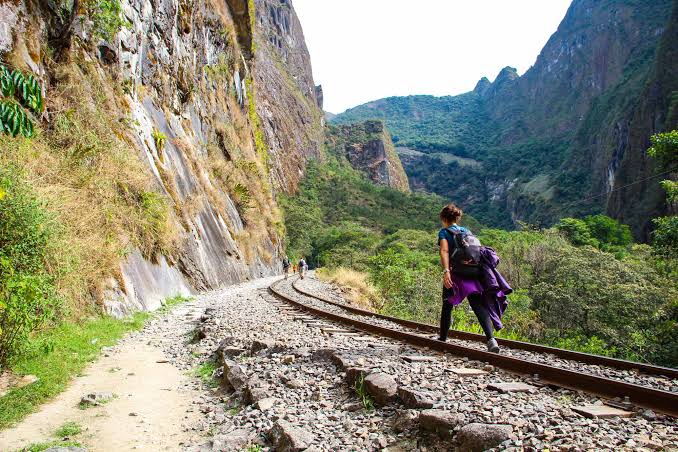
It is roughly ten kilometers of nearly flat terrain, following the railway between the mountains and the river. The route alternates between sections beside the tracks and parallel trails, crossing small bridges and areas of dense vegetation. There is no technical difficulty; the only challenge is the distance combined with the fatigue from the previous days.
It takes two and a half to three hours, depending on your pace. Along the way, there are stalls where you can buy water and drinks, and much of the route is shaded.
What you will see along the way
This stretch is more beautiful than many people expect. You walk through lush cloud forest, surrounded by orchids, ferns, and butterflies, with the river below for most of the way. At one point, looking up, you can make out part of the Machu Picchu citadel among the vegetation.
Railway safety rules
Trains run on this line every day. Always walk along the side, move aside when you hear one approaching, and do not wear headphones on narrow sections or bridges. Do not stop on the tracks to take photos either.
The train from Hidroeléctrica
Hidroeléctrica station has daily departures to Aguas Calientes, operated by the train companies serving the line. The journey takes less than an hour and follows the same canyon you would see on foot, but seated and with wide windows.
Schedules and availability
There are only a few departures per day, all at fixed times. This changes your entire planning: if you want to take the train, you need to arrive at Hidroeléctrica in time for one of those departures, not the other way around.
During high season, seats sell out. If you prefer this option, ask your agency when booking the trek so they can purchase the ticket in advance and adjust the day’s schedule.
Buying it on the spot
You can try to buy a ticket at the station that same day, but it is a gamble. Outside high season, there are usually seats available; between June and August, do not count on it.
Train or walk: how to decide
| Factor | On foot | By train |
|---|---|---|
| Duration | 2 h 30 min to 3 h | Less than 1 h |
| Cost | Free | Separate ticket |
| Schedule | Leave whenever you want | Fixed and limited departures |
| Luggage | You carry it yourself | With a weight limit |
| Scenery | Up close, at your own pace | From the window |
| Effort | High after several trekking days | None |
Walk if you arrive with energy, if your group is staying together, and if you want to finish the trek on foot all the way. Take the train if you have an injury or discomfort, if you arrive late and do not want to walk after dark, if you are traveling with young children or older adults, or if you are carrying your own bag and it is heavy.
Luggage on this stretch
This is the point that surprises travelers the most. The mules no longer accompany the group, and on many itineraries each person carries their own bag from Hidroeléctrica.
Ten kilometers with a seven-kilo bag on your shoulder, after four days of trekking, feels like a lot. If you take the train, there is also a carry-on luggage limit per passenger. Learn how all of this works in luggage transport on the Salkantay Trek, and ask your agency who carries what on this stretch.
If you walk, timing matters
The canyon is deep, and it gets dark earlier than in open areas. Plan your departure to reach Aguas Calientes while it is still light: ideally, start walking no later than mid-afternoon.
If you need to walk in low light, keep your headlamp handy and stay with the group. The trail is easy, but the bridges and sections beside the railway require attention.
What happens when you arrive in Aguas Calientes
Both routes end in the same town, just a few minutes’ walk from the center. There, the guide hands out the tickets, confirms the meeting time for the following day, and the group checks into the hotel.
It is the only night of the trek spent indoors, with a hot shower and a bed. Make the most of it: the visit to the sanctuary starts early the next day.
And when the trek is over, you still need to decide how to get back. We explain it in how to return to Cusco after the Salkantay Trek.
Frequently asked questions
Is the train from Hidroeléctrica included in the Salkantay Trek?
On most tours, no. This stretch is usually done on foot, and the train is an optional service at an additional cost. Ask when booking.
Is it dangerous to walk beside the railway?
It is a route used daily by hundreds of people and presents no difficulty. The key is respecting train traffic: walk along the side, move aside when one approaches, and do not stop on bridges or bends.
Can I take the train one way and walk back?
Yes, the tickets are separate. Many travelers take the train to Aguas Calientes to arrive well-rested and walk back to Hidroeléctrica on their return day.
Is there anywhere to buy water or food along the way?
Yes. Near Hidroeléctrica station there are restaurants and shops, and along the trail you will find a few stalls selling drinks and snacks. Even so, set out with enough water for the three hours.
How long does the train from Hidroeléctrica to Aguas Calientes take?
Less than an hour. The real difference compared with walking is not just the travel time, but also the wait until the scheduled departure, which can be long if you arrive just after a service has left.