


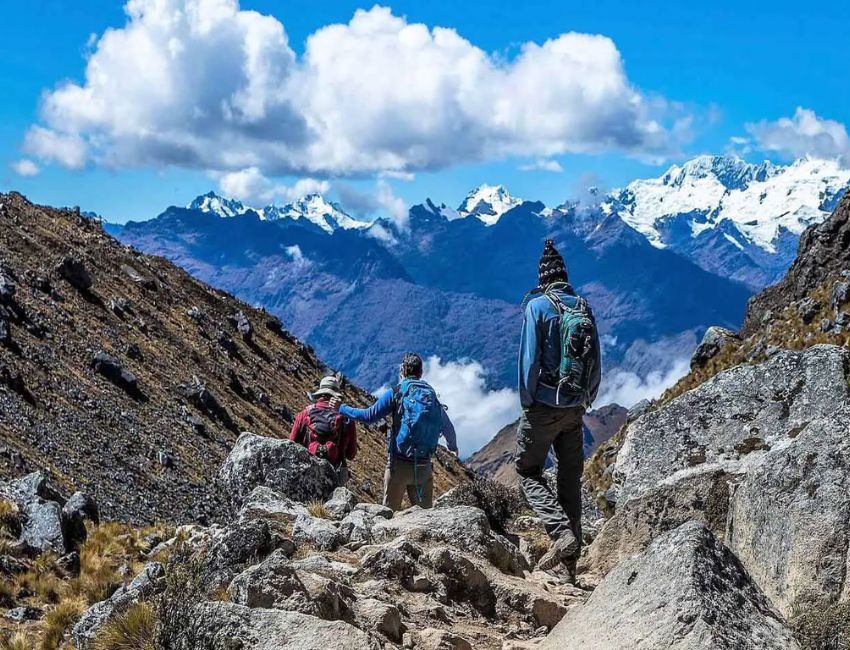
One group leaves the trail to take a photo on a rock, another leaves fruit peels near the campsite, and someone takes out a drone at the mountain pass. All three scenes happen every season, and all three are prohibited, although almost no one knows it until a park ranger or guide steps in. The Salkantay route crosses communal lands, natural areas and, on its final stretch, a protected sanctuary, each with its own rules. Knowing them helps you avoid fines, arguments and, in the worst-case scenario, losing entry to Machu Picchu.
Who regulates each section of the route
This is the first thing to understand, as the rules change depending on where you hike.
The upper section, from Mollepata to the descent from the mountain pass, crosses the territories of farming communities and grazing areas. Here, community agreements apply: entrance fees, designated camping areas and trail use.
The high jungle section combines private property, family farms and public roads.
The final section, around Machu Picchu, enters the Historic Sanctuary, a protected area with strict conservation rules and its own regulations for visiting the citadel.
Rules during the hike
Waste
Everything brought onto the route must leave with the group. There is no garbage collection in the upper section, and waste left at campsites ends up scattered by wind or animals.
This includes fruit peels and cigarette butts. At that altitude, organic waste takes months to break down.
Fire
Campfires are prohibited along the route. Agency kitchens use gas, and that is the only permitted fire, always under the team’s supervision.
The risk is real: during the dry season, puna grasslands and coffee plantations in the lower area catch fire easily.
Where you can camp
Only in designated areas, which belong to families or communities and charge a fee. Wild camping on any hillside is not allowed, even if it looks like empty land: it always belongs to someone.
The trail
Stay on the marked route. Shortcuts erode hillsides, destroy very slow-growing vegetation and increase the risk of accidents.
Flora and fauna
Do not pick flowers or orchids, collect plants or seeds, or feed wild animals. Removing species is prohibited, and taking them out of the country is regulated.
The communities
Ask permission before photographing anyone, do not enter farms or livestock pens without an invitation, and pay community fees where applicable. Learn more about interacting with trail families in towns and communities along the Salkantay Trek route.
Drones
Their use is restricted and outright prohibited in protected areas and in Machu Picchu. If you plan to film with a drone anywhere along the route, check beforehand which permits are required, because not knowing the rules does not prevent a penalty.
Rules inside the sanctuary
On the final section, once inside the protected area, the rules become stricter because any damage affects a protected ecosystem and archaeological site.
- Making fires and camping outside authorized areas are prohibited.
- You may not leave designated trails.
- Plants, stones and any other elements from the site may not be removed.
- All waste leaves with you, without exception.
- Walking alongside the railway requires giving way to trains and not stopping on bridges.
Machu Picchu entry rules
Visiting the citadel has its own regulations, and this is where most people get surprised.
| Rule | What it means |
|---|---|
| Timed entry and circuit | One-way route, with no detours or backtracking |
| No re-entry | If you leave, your ticket is considered used |
| Required document | Original passport matching the ticket |
| Limited luggage | Small backpacks only; everything else goes to luggage storage |
| No food | No food is allowed inside, and there are no sales within the site |
| Restricted trekking poles | Allowed only in specific cases and with rubber tips |
| No drones or tripods | Prohibited throughout the entire site |
| Single-use plastics | Restricted: bring a reusable bottle |
| Respect for the structures | Do not climb, lean on or touch the walls |
| Conduct | Running, jumping fences, smoking and making excessive noise are prohibited |
Find out how that final morning unfolds, hour by hour, in arriving at Machu Picchu after the Salkantay Trek.
What penalties apply
They range from administrative sanctions to criminal charges, depending on the severity.
The most common consequence is removal from the site without a refund. Anyone who leaves the circuit, enters with prohibited items or behaves inappropriately may be removed immediately by control staff.
Beyond that, there are administrative fines and, in cases involving damage to structures or removal of elements from the site, police intervention. Cultural heritage is protected by law, and damaging it may lead to a formal complaint, in addition to an entry ban.
In the protected natural area, violations such as making fires, leaving waste or removing species also carry administrative penalties.
And there is one consequence that affects everyone: if your group breaks the rules, the agency is accountable to the authorities and the rest of the travelers lose time during the process.
What your agency must also comply with
The rules are not only for travelers. The operator must be registered, work with accredited guides, comply with adventure tourism safety regulations and respect the rules for using campsites and the sanctuary.
Learn how to check whether an agency operates legally in criteria for verifying whether a Salkantay Trek agency is legal.
Following the rules effortlessly
Almost all the rules can be summed up in three habits: stay on the trail, take out what you bring in, and ask before doing something you have not seen anyone else do.
And one practical rule for the final day: check your backpack before reaching the sanctuary entrance. Most issues at the checkpoint are caused by items that could have been left at the hotel.
Frequently asked questions
Can I bring a drone on the Salkantay Trek?
It is prohibited in Machu Picchu, and its use in protected areas requires authorization. Check current regulations before traveling, as penalties include confiscation.
Can I use trekking poles in Machu Picchu?
Only in specific cases, such as for elderly people or visitors with reduced mobility, and always with rubber tips. For all other visitors, trekking poles must be left at the entrance luggage storage.
Can I camp anywhere along the route?
No. Camping is only allowed in designated areas belonging to families or communities that charge a fee. In the protected area on the final section, camping outside authorized locations is prohibited.
What happens if I leave the circuit inside Machu Picchu?
Control staff may warn you and, depending on the severity, remove you from the site without a refund. Circuits are one-way and do not allow detours.
Can I enter the citadel with food?
No, and there are no points of sale inside. Have a good breakfast in Aguas Calientes and enter with your reusable bottle full.