


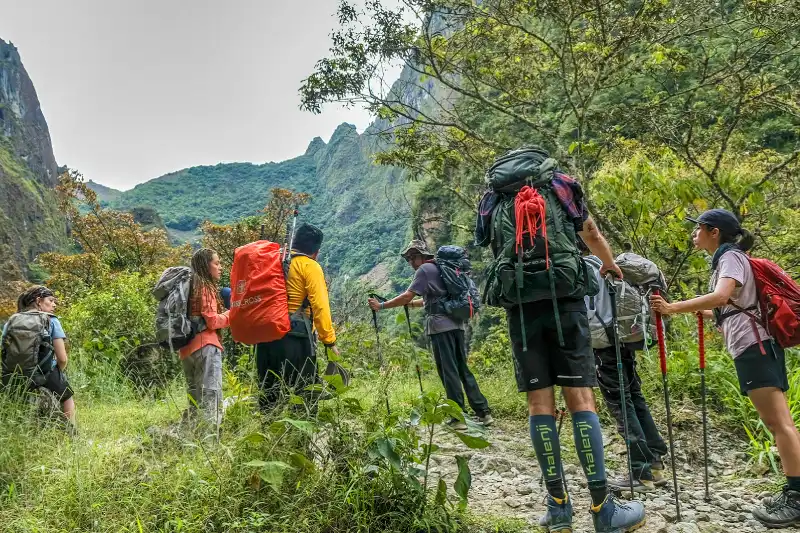
Two mistakes are repeated every season on the climb to the mountain pass. The first is arriving with a sixty-liter backpack when the mules are already carrying almost all your gear: you end up hauling a huge, half-empty pack that shifts with every step. The second is the opposite: a school backpack without a hip belt, which puts all the weight on your shoulders and leaves you with neck and back pain by mid-morning. Both can be avoided by choosing wisely before you travel, and neither has a solution once you are at 4 600 m s. n. m.
What backpack you need based on how you travel
The right capacity depends on one thing only: whether someone else carries your gear or you carry everything yourself.
| How you travel | Recommended capacity | What you carry |
|---|---|---|
| With an agency and mules | 25 to 30 liters | Day gear only |
| With an agency and you want extra room | 30 to 35 liters | Day gear plus a camera or extra layer |
| Independently with a hired muleteer | 30 to 40 liters | Day gear and part of your equipment |
| Independently, carrying everything | 55 to 70 liters | Tent, sleeping bag, food, and clothing |
The vast majority of travelers fall into the first category. With an agency, a 25 to 30-liter backpack is the size that works: it fits your water, warm layer, food for the day, and camera, without extra space that tempts you to pack more than you need.
What goes inside each bag—yours and the mules’—is detailed in luggage transport on the Salkantay Trek.
Features that really matter
Padded hip belt
This is the most important feature and the one most often overlooked. A good belt transfers most of the weight to your hips, which are much stronger than your shoulders. On six- to eight-hour days, that difference determines how you feel at the end of the day.
A thin fabric strap does not count. It needs to be wide, padded, and adjustable.
Ventilated back panel
On the descent toward the high jungle, you will sweat quite a bit. A back system with mesh or ventilation channels reduces moisture and makes the final hours of the day more comfortable.
Sternum strap
It keeps the shoulder straps in place and prevents the backpack from pulling outward on descents. Small, but noticeable.
Rain cover
Many trekking backpacks come with a cover stored in a bottom pocket. If yours does not have one, buy it separately. It can rain in the high jungle even during the dry season, and a garbage bag over your backpack works but tears easily.
Accessible pockets
Mesh side pockets for bottles and one on the hip belt for snacks or sunscreen save you from stopping the group every time you need something. On the climb to the mountain pass, stopping and getting going again takes more effort than it seems.
Trekking pole attachment
If you use trekking poles, you will want to store them at some point, especially on flat sections and during the walk alongside the railway tracks. Side straps solve that without having to carry them in your hand.

Fit: the detail almost no one checks
Trekking backpacks are made in sizes based on torso length, not height. A backpack with a torso that is too long positions the hip belt poorly and shifts the weight back onto your shoulders.
If you buy one in a store, ask to be measured and try it on with weight inside, not empty. Many models have versions designed for shorter torsos and wider hips, which often fit most women better.
How to adjust it before you start hiking
A good backpack that is poorly adjusted performs like a bad backpack. Follow this order:
- Loosen all the straps before putting it on.
- Position the belt over your hip bones, not your waist, and tighten it firmly.
- Adjust the shoulder straps until they rest against your body without bearing weight.
- Tighten the upper load-lifter straps to bring the backpack closer to your back.
- Fasten the sternum strap without tightening it so much that it makes breathing difficult.
If you feel all the weight on your shoulders while walking, the belt is positioned incorrectly. Check it at the first stop.
How to distribute weight inside
The heaviest items, such as water, should go close to your back and at mid-height, not at the bottom or hanging away from your body. This position keeps your center of gravity close to your body and gives you stability on rocky sections.
Light, bulky items, such as your jacket, go on top or in the outer pockets. Keep what you need at hand in the hip belt pocket or top lid: sunscreen, snacks, documents, and a flashlight.
Keep everything inside waterproof or zip bags. This is more effective than relying only on the outer cover and lets you find things without emptying your backpack.
Buying or renting in Cusco
In Cusco, there are outdoor gear stores that sell and rent backpacks. Renting makes sense for large-capacity packs if you are traveling independently and do not want to buy one for a single trip.
For your daypack, it is best to bring your own, already tested. You will wear it for eight hours a day for five days, and a new backpack that rubs in one specific spot becomes unbearable by the second day.
If you buy one at the local market, check the seams, zippers, and hip belt padding before paying. There are affordable options that do the job and others that break on the first demanding section.
Frequently asked questions
How much should my daypack weigh?
Between five and eight kilos, including water. Above that, the climb to the mountain pass becomes much harder than necessary.
Can I use a hydration pack as a daypack?
Only if it has at least twenty liters and a hip belt. Small cycling models do not have enough room for a warm layer, food, and a camera for the entire day.
Do I need a waterproof backpack?
The fabric itself does not need to be waterproof. A rain cover and inner bags are enough to protect your clothing, camera, and documents.
Can I take my daypack on the return train?
Yes, but trains have a carry-on luggage limit per passenger. If you add up your backpack and trek bag, check the allowed weight before traveling.
Should I use a brand-new backpack on the trek?
No. Use it first on a long hike with real weight. That way, you can spot rubbing points and adjust the straps long before you are on the trail.