


Your transport picks you up at five, but the guide says they’re leaving ahorita nomás. At the briefing, they talk about the duffel bag, the cupo and the ingreso, and the next day someone mentions that if there is a huayco, the road closes. All these words are in Spanish, yet they can still sound like another language because in Cusco and along the route they have their own meaning. Understanding them prevents misunderstandings about schedules, prices and services, and can save you from more than one tricky situation during the trek.
At the agency, before departure
- Charla informativa: the pre-trek briefing, usually held the afternoon before, where you meet the guide, receive the bag for the mules and get your questions answered. Do not miss it: this is where you get details that are not in the itinerary.
- Cupo: an available spot on a departure or in a limited-capacity service, such as entry to Machu Picchu or the train.
- Ingreso: the entry ticket for Machu Picchu. When someone asks whether you already have your ingreso, they mean that, not your arrival time.
- Recojo: the time when the agency picks you up from your hotel. If they tell you pickup is at four thirty, you should be downstairs and ready at that time.
- Adelanto: the partial payment that confirms your reservation, with the remaining balance paid when you arrive in Cusco.
- Jalador: a person who offers tours on the street for commission. Many work for legitimate agencies, but it is always best to book at the office.
Transportation
- Movilidad: any vehicle used to transport passengers, from a van to a hired private car.
- Colectivo: shared transport with no fixed schedule that leaves when it is full. This is what connects La Playa, Santa Teresa and Hidroeléctrica.
- Combi: a public minibus used for urban or intercity transport.
- Paradero: the point where vehicles depart or stop. It is not always marked: sometimes it is simply a corner everyone knows.
- Carro: used for any vehicle, not just a car.
Learn how these sections connect in transportation during the Salkantay Trek.
The people on the trail
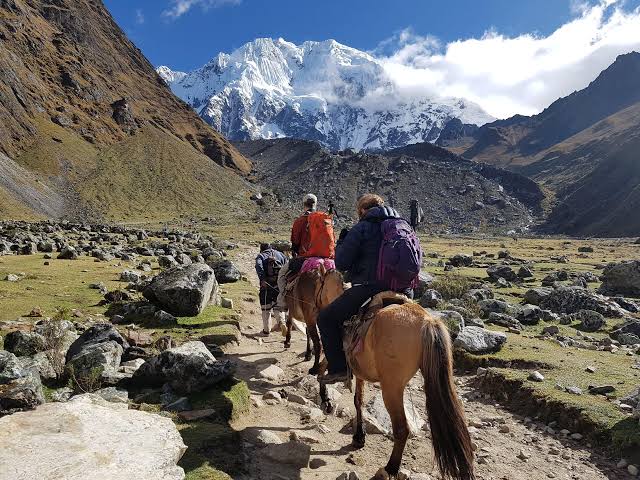
- Arriero: the person who leads the mules and horses carrying the luggage. It is the key term on this route, where there are no porters: those belong to the Inca Trail, which does not allow pack animals.
- Comunero: a member of a rural community, with rights over the communal lands crossed by the route.
- Maestro: a respectful form of address for a skilled worker, whether the driver, cook or muleteer.
- Paisano: a friendly way to address someone from the area.
Learn how muleteers work in luggage transport on the Salkantay Trek.
Terrain and weather
- Abra: a mountain pass, the highest point between two valleys. The Salkantay Pass is the key moment of the trek.
- Quebrada: a narrow valley where water flows down.
- Ceja de selva: the belt where the Andes descend toward the Amazon, warm and humid. It is the final section of the route.
- Puna: the high grassland zone above the tree line.
- Huayco: a landslide of earth and rocks carried by water. During the rainy season, it can close roads for hours or days.
- Chacra: a family farming plot. You will see many on the descent toward the valley.
- Piscigranja: a trout farm. This is where the fish you eat in Santa Teresa comes from.
At the table
- Menú: not the menu card, but the complete fixed-price lunch of the day, with soup, main course and drink.
- Segundo: the main course served after the soup.
- Refresco: the drink served with the menú, usually a cold herbal infusion or fruit juice.
- Yapa: the free extra you receive when buying something, such as an additional piece of fruit or a little more food.
- Box lunch: the packed lunch provided by the agency on days without a dining setup.
Find the specific dishes in typical food on the Salkantay route.
Health and altitude
- Soroche: altitude sickness, with headaches, nausea and fatigue.
- Chacchar: chewing coca leaves, an everyday practice among people who work at high altitude.
- Manta blanca: tiny insects that bite in the high jungle area and leave itchy marks for days.
- Posta: the health clinic in a small town.
Learn how to protect yourself from manta blanca in mosquitoes on the Salkantay Trek.
Money and shopping
- Sencillo: small bills and coins. Along the route, people will ask if you have sencillo because nobody has change for large bills.
- Luca: a colloquial way to refer to one sol.
- Bodega: a small village shop where you can buy all kinds of things.
- Boleta: the payment receipt that any formal business must give you.
Time expressions
This is the section that prevents the most misunderstandings.
- Ahorita: it can mean in one minute or in half an hour. It is not imprecision; it is simply a way of speaking.
- Al toque: right away, this very moment. This one really is immediate.
- Un ratito: a brief moment, although it can be flexible.
- Nomás: added at the end to soften a phrase. Pasa nomás, despacio nomás.
- Ya: means okay, understood. It does not mean that something has already happened.
A practical tip: for trek schedules, such as pickup or departure from camp, confirm the exact time with your guide. Those are followed to the minute.
Phrases you will hear
- Despacio nomás: the advice you will hear most often on the climb to the pass. It is the local way of saying that a slow pace is the right pace.
- Poco a poco: the same idea, and it works.
- ¿Estás bien?: the guide’s question when someone starts falling behind. Answer honestly.
- Ya mero llegamos: we are almost there, although “almost” is relative.
- Buen provecho: said when starting a meal and also when walking past someone who is eating.
Find the Quechua words you will hear along the same route in the Salkantay Trek glossary.
Frequently asked questions
Do I need to speak Spanish to do the Salkantay Trek?
No, because there are guides in English and other languages. But outside the group, in shops, eateries and colectivos, Spanish is the language in everyday use, and a few words will solve almost everything.
Why do people say movilidad instead of bus?
Because movilidad covers any hired vehicle used to transport passengers, regardless of its size. It is the usual term in Peru’s tourism sector.
What is the difference between an arriero and a porter?
An arriero leads pack animals and carries the luggage on the Salkantay route. A porter carries weight on their back and works on the Inca Trail, where mules and horses are not allowed.
If someone tells me ahorita, how long should I wait?
It can mean anywhere from one minute to half an hour. If you need precision, ask for the exact time instead of relying on ahorita.
What is yapa?
It is the small free extra given by the seller, such as an extra piece of fruit or a little more on your plate. You do not ask for it: you thank them when it arrives.