


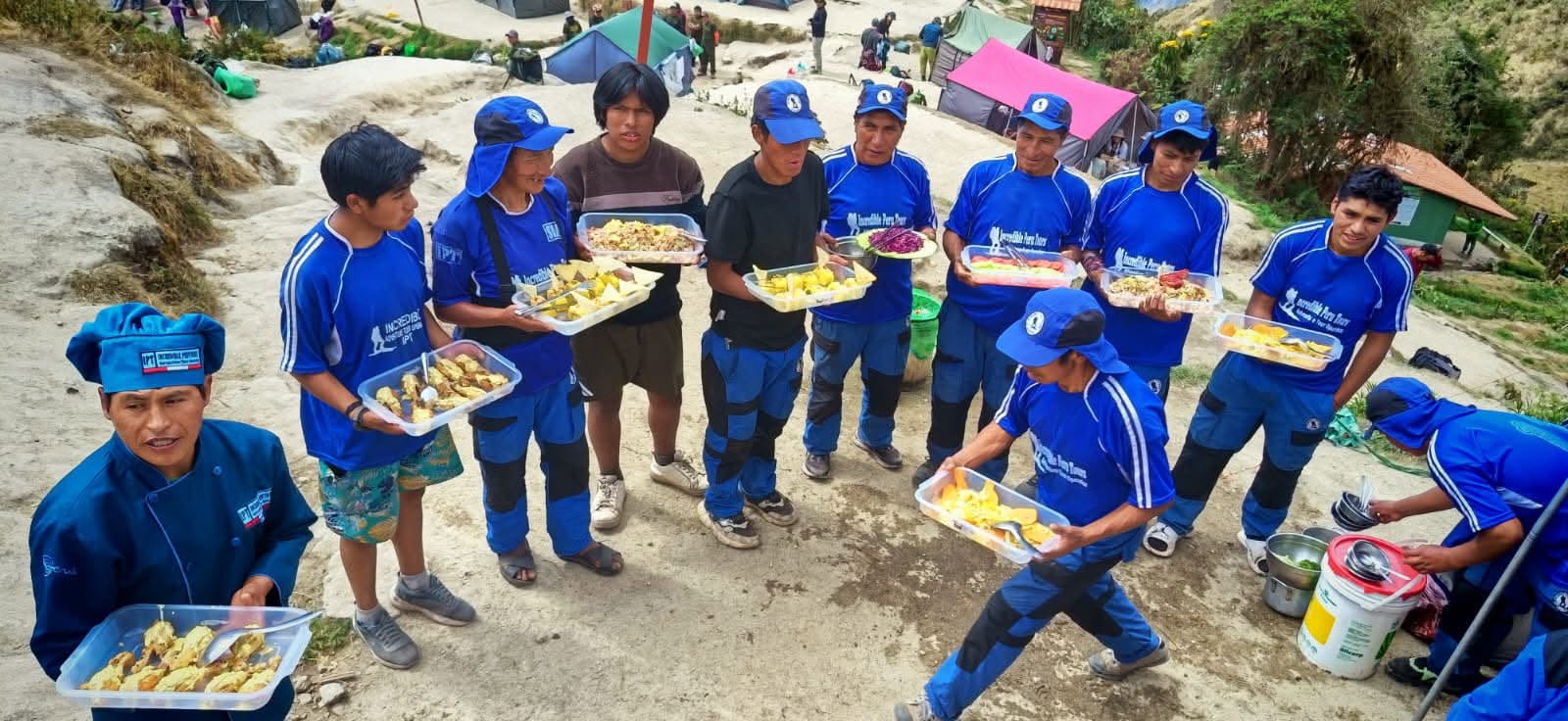
One of the most common questions before booking the Salkantay Trek is what to do about tips: whether they are mandatory, how much to give, and who to tip. The short answer is that they are not mandatory, but they are part of the custom on multi-day treks. Behind your hike is a team that works long hours at high altitude to make sure everything runs smoothly: guide, cook, kitchen assistant, and muleteers. Tipping is the usual way to recognize their work when you are satisfied with the service.
In this guide, we explain how tips are shared, how much each traveler usually contributes, and what details you should have sorted out before leaving Cusco.
Are tips included in the tour price?
No. The package price covers transportation, guiding, meals, camping or domes, entrance fees, and train tickets, depending on the type of service you book. Tips are not included and are up to you. They are understood as voluntary and linked to the level of service you receive during the trek, not as a fixed charge.
How much is customary to give?
There is no single amount, and you will see different ranges depending on the agency and the length of the trek. As a general reference, many travelers calculate between USD 9 and USD 12 per day per person, which on a four- or five-day trek usually adds up to approximately USD 36 and USD 47 per hiker. This amount is collected from the whole group and shared among the team at the end.
If you prefer to calculate it by each team member’s role rather than by day, this table provides a reference for the distribution commonly used. The amounts are per traveler in the group, not for the entire group, and are always only a suggestion:
| Team role | Suggested amount per traveler for the entire trek |
|---|---|
| Guide | USD 24 to USD 27 |
| Cook | USD 24 to USD 27 |
| Kitchen assistant | USD 12 to USD 18 |
| Muleteer | USD 12 to USD 15 |
A practical rule that often works well is for the guide and cook to receive a little more than the rest of the team, as they accompany the group for longer and carry greater responsibility. The muleteer, on the other hand, is usually present for only some days of the trek. As a general reference, total tips for the entire trek range from USD 40 to USD 80 per traveler, although you can adjust the amount up or down depending on your experience with the service.
Tips are usually not given person by person, but collected into a shared group fund. At the end of the trek, someone in the group acts as treasurer, collects each traveler’s contribution, and gives the money to the team all at once. Many groups take advantage of the final night to hold a small thank-you gathering and present the tips.
There is one logistical detail worth knowing: the kitchen team and muleteers do not always reach the end of the trek with the group. In many operations, they say goodbye after lunch on the second-to-last day to return to their communities, while the guide continues on to Machu Picchu. For this reason, tips for the cook, kitchen assistant, and muleteers are usually given before the guide’s tip, which is normally presented after the guided visit ends. Your guide will explain how the distribution works for your specific departure, so the easiest thing is to follow their instructions.
Cash, local currency, and small bills
There are no ATMs or card payment terminals along the trek, so everything is handled in cash. Although the amounts in this guide are expressed in US dollars, it is usually more practical to bring Peruvian soles in small denominations.
If you decide to bring US dollars, try to have small bills of USD 20, USD 10, USD 5 and USD 1. Large bills can be difficult to exchange during the trek, and splitting a shared fund is much easier with small denominations. That same cash can also be used to pay for expenses not included in the package, such as breakfast on the first day, water, additional drinks, or lunch on the final day.
What happens if the service was not good?
Tipping is voluntary and reflects your level of satisfaction. If for any reason the service did not meet your expectations, you have the right to reduce the amount or not leave a tip. The final amount is a personal decision.
Likewise, if the team gave you a better experience than expected, you can increase your contribution as a direct way to recognize their work. Small gifts for team members or their families are also usually received with appreciation.
Frequently asked questions
Is it mandatory to tip on the Salkantay Trek?
No. Tipping is voluntary and depends on your level of satisfaction with the service. It is considered a common custom on multi-day treks, but it is not a charge included in the tour price.
Which currency is best for tipping?
The most practical option is to give tips in Peruvian soles and in cash, using small-denomination bills. However, some teams may also accept US dollars. Cards do not work on the trek, and large bills can be difficult to exchange.
Is the tip given separately to each team member?
The usual practice is to collect a shared fund from all travelers in the group and give it to the team at the end of the trek. Your guide will tell you the time and method of delivery based on how your departure is organized.
How much should I budget in total?
As a reference, you can budget approximately between USD 36 and USD 47 per traveler for the entire trek. Some travelers set aside between USD 40 and USD 80, depending on the trek length, team size, and their level of satisfaction with the service.
Who should receive a larger tip?
By custom, the guide and cook usually receive a little more than the kitchen assistant and muleteers, as they accompany the group for longer and take on greater responsibility throughout the trek.