


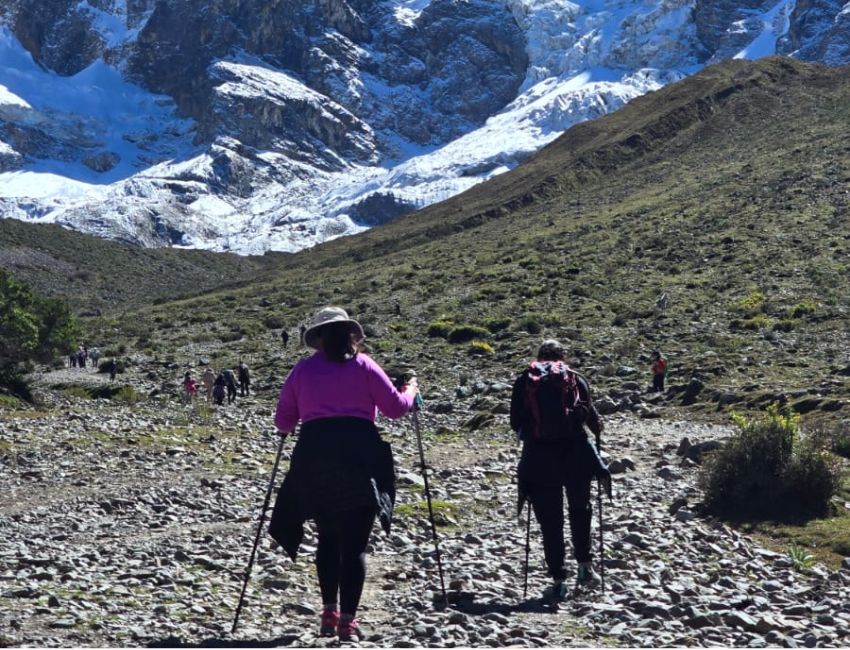
Staying well hydrated is an important part of preparing for the Salkantay Trek. For several days, you will walk across different types of terrain, face temperature changes, and exert yourself physically for many hours, so having sufficient access to water should be part of your planning before leaving Cusco.
However, one of the most common questions among travelers is very simple: how much water should I bring on the Salkantay Trek?
The answer is not to carry all the water you need for several days. On organized tours, there are usually designated times to refill bottles, although the exact service depends on each operator.
For example, some Salkantay operators currently state that travelers should bring enough water for the first morning, and that they subsequently provide boiled water to refill bottles during meals and at campsites.
In this guide, we explain how much water capacity you should bring, where you can refill it, what type of bottle to use, and what you should ask your agency before starting the trek.
How much water should you bring on the Salkantay Trek?
Rather than thinking only about a fixed number of liters you need to drink each day, it is more practical to consider how much water you need to carry between one refill point and the next.
Each person’s needs can vary depending on factors such as:
- The length of the day.
- Your walking pace.
- The temperature.
- The intensity of the effort.
- How much you sweat.
- Each traveler’s individual conditions.
That is why there is no single figure that is correct for absolutely everyone.
As a gear reference, some operators running trekking routes in the area recommend bringing a bottle or hydration bladder with an approximate 2-liter capacity.
This does not mean you have to drink exactly two liters throughout the day. It means that having this capacity may allow you to carry enough water between certain supply points.
Is there water during the Salkantay Trek?
Yes, on an organized tour there is usually a water supply, but you should check exactly how it works with the agency you booked with.
A major route operator currently states that travelers should bring enough water for the first morning. Afterwards, it provides boiled water at breakfast, lunch, and dinner to refill bottles or hydration bladders.
Other operators may have different arrangements.
Before starting, always ask:
From what point do you provide water?
At which meals can I refill my bottle?
How much capacity should I bring?
Will I need to buy water during any part of the trek?
Is water included in the tour price?
Having these answers before leaving Cusco will help you organize your backpack much better.
Bring enough water for the first part of the trek
This point is especially important.
Do not assume you can start hiking with an empty bottle because water will be available right away.
Some operators explicitly ask travelers to arrive with enough water to cover the first morning of the hike, providing water later on.
During the pre-tour briefing, confirm how much you should bring from Cusco or from the starting point.
Your guide knows the specific itinerary and where the next refills will be available.
Reusable bottle or hydration bladder?
Both options work well, and many travelers even combine them.
Reusable bottle
It is simple, easy to clean, and lets you visually check how much water you have left.
It is also practical for refilling during meals.
Its advantages include:
- Easy to clean.
- Easy to monitor the amount remaining.
- Good durability.
- Less waste than continually buying disposable bottles.
Hydration bladder or CamelBak
A hydration bladder is stored inside your backpack and uses a tube so you can drink while walking.
Its main advantage is that you do not need to stop or take out a bottle every time you want to drink.
It can be especially comfortable on long days.
If you choose this option, make sure you have tested it before your trip and check that it does not leak.
What capacity should you bring?
For many travelers, around 2 liters of total capacity can be a practical guideline, and this capacity is currently recommended by some trekking operators in the area.
You can distribute it in different ways.
For example:
- One hydration bladder.
- Two reusable bottles.
- One bottle and one hydration bladder.
The best setup will depend on your backpack and preferences.
The important thing is knowing how long you will walk between refills.
Drink regularly while hiking
During prolonged physical activity, it is important to drink regularly and adjust your hydration to the conditions and level of exertion.
The U.S. National Park Service advises drinking small amounts frequently during demanding hikes, especially in hot weather, rather than waiting too long between drinks.
A simple strategy during the Salkantay Trek is to take small sips periodically.
A hydration bladder can make this habit easier because you can drink while walking without taking off your backpack.
Does altitude change hydration needs?
The Salkantay Trek reaches considerable altitudes. The CDC specifically identifies the Salkantay Trek, whose pass reaches approximately 4,630 meters, as a high-altitude activity where there is a risk of altitude-related illness.
In addition, high-altitude environments often combine factors such as low humidity, cold temperatures, and greater exposure to ultraviolet radiation.
That is why it is advisable to pay attention to both hydration and other aspects of preparation.
However, drinking large amounts of water does not replace proper acclimatization.
Preventing altitude-related problems depends especially on ascending gradually and giving your body time to adapt. The CDC recommends gradual acclimatization for travelers heading to high-elevation destinations.
Hydration and altitude sickness are not the same thing
This point is important to avoid confusion.
Staying properly hydrated is necessary during a hike, but water alone does not prevent altitude sickness.
You should not think:
“If I drink a huge amount of water, I will not get altitude sickness.”
Adaptation to altitude depends mainly on the acclimatization process and the rate of ascent. The CDC specifically recommends gradual adaptation before reaching higher elevations.
That is why hydration should be part of broader preparation that includes:
- Acclimatization.
- An appropriate pace.
- Rest.
- Nutrition.
- Appropriate gear.
- Paying attention to any symptoms.
Where can you refill water during the Salkantay Trek?
The answer depends on the operator and the itinerary.
On organized tours, one common approach is to provide treated water during certain meals.
For example, Salkantay Trekking currently states that it provides boiled water at breakfast, lunch, and dinner after the first morning of its route.
This allows you to refill your bottle or hydration bladder before continuing.
That is why it is essential to bring a reusable container.
Are there shops to buy water?
In some parts of the route, you may find small shops or kiosks selling water, drinks, and snacks.
A route operator notes that there are occasional shops in certain sections of the trail where travelers can buy additional water.
However, you should not rely on finding them completely.
Availability can vary, and some sections are much more remote.
Consider shops an additional option, not your only strategy for staying supplied.
Can I drink directly from rivers or streams?
It is not advisable to drink water directly from a natural source simply because it looks clean.
Clear water can contain microorganisms or other contaminants that you cannot see.
If you need to use water from a natural source, it must be treated using an appropriate method before drinking it.
On organized tours, the simplest option is usually to use the safe water provided by the agency at designated points.
Ask your guide before using any source you find along the route.
Should I bring a water filter?
If you do the Salkantay Trek with an agency that provides safe water along the route, you may not need a personal filtration system.
However, some travelers prefer to bring one as a backup.
Before buying extra gear, ask your agency:
- Whether it provides water throughout the trek.
- At which meal the service begins.
- How the water is treated.
- How many times you can refill.
- Whether there is any day when you need to buy or carry more water.
This way, you will avoid carrying gear that you may never use.
Do I need water treatment tablets?
Not necessarily if your operator already supplies safe, treated water.
They can be part of a personal kit for certain travel styles, but they should not be used without properly understanding the product instructions.
If you have questions about water treatment on your route, ask the agency first.
Are electrolytes necessary?
During prolonged physical activity, you also lose salts through sweat.
In hot conditions or during prolonged exertion, organizations such as the National Park Service recommend combining proper hydration with food and electrolyte sources according to hiking conditions.
This does not mean every traveler needs to consume sports drinks constantly.
For many people, proper nutrition and regular hydration are the foundation.
If you are used to using electrolytes on long hikes, you can bring individual packets because they take up very little space.
Do not try large amounts of new products for the first time during the trek.
Cold water or hot drinks?
In the coldest areas of Salkantay, you may feel less like drinking water.
This is where hot drinks can be pleasant.
Depending on the operator, campsites may offer tea, coffee, hot chocolate, or other drinks during meals or in the afternoon. Some current Salkantay services include these types of drinks at their campsites.
Even so, remember to keep your bottle ready for the next day’s hike.
How do I know how much water I have left?
A simple mistake is walking for hours without checking your remaining water.
If you use a transparent bottle, you can see it easily.
With a hydration bladder, it is less obvious.
During breaks:
- Check how much water is left.
- Ask the guide how far it is to the next refill point.
- Adjust your intake according to the remaining section and the conditions.
- Refill completely when necessary.
Do not wait until your bottle is completely empty before asking where the next refill is.
Your guide is your best reference during each day
Your guide knows the day’s itinerary.
Before starting each stage, you can ask:
How many hours will we walk before lunch?
Will we be able to refill water before then?
How much water do you recommend carrying for this section?
This information is more useful than using exactly the same amount every day.
A short, cool day may have different needs than a long, sunny one.
Keep water accessible
Do not store all your water at the bottom of your backpack.
If drinking requires you to stop, take out several items, and reorganize your gear, you will probably end up doing it less often.
You can use:
- Backpack side pockets.
- An accessible bottle holder.
- A hydration bladder with a tube.
The idea is to make drinking easy while you walk.
Do not rely on disposable plastic bottles
A reusable bottle or hydration bladder is generally much more practical for a multi-day hike.
In addition, route operators currently recommend bringing reusable containers and avoiding unnecessary waste from disposable bottles.
Salkantay passes through sensitive natural environments, so every traveler should carry their waste to a suitable disposal point.
What to do with your bottles at night
Before going to sleep:
- Ask when the next refill will be.
- Check your containers.
- Clean them if necessary.
- Leave them ready for the morning.
- Make sure the caps are tightly closed.
This saves you time while preparing your backpack before starting an early day.
- Starting the hike with too little water
- Thinking there will be shops everywhere
- Bringing a bottle that is too small
- Carrying too much unnecessary water
- Not asking the agency what is included
- Drinking directly from a natural source
- Confusing hydration with acclimatization
What to ask during the Salkantay Trek briefing
Before leaving Cusco, take advantage of the meeting with your guide to clarify everything related to water.
You can ask:
- How much water should I bring on the first day?
- When will the first refill be?
- Do you provide water every day?
- Is water included in the price?
- Where are the refill points?
- What bottle capacity do you recommend?
- Are there places to buy drinks?
- Do I need a personal treatment system?
These simple questions will help you start much better prepared.
What should you bring specifically for hydration?
For many travelers, simple gear is enough:
- A reusable bottle or hydration bladder.
- An approximate capacity of up to 2 liters, depending on what your operator indicates.
- A second small bottle if you prefer to have a backup.
- Some electrolytes if you already use them regularly.
- An additional treatment system only if your type of travel requires it.
You do not need to turn your backpack into a complex system.
The key is having enough capacity, easy access to water, and knowing the refill points.
Frequently asked questions about hydration on the Salkantay Trek
How much water should I bring on the Salkantay Trek?
It depends on the itinerary and refill points. As carrying capacity, some operators currently recommend approximately 2 liters. Always confirm your agency’s specific recommendation.
Does the agency provide water during Salkantay?
It depends on the company. Some operators offer boiled water after the first morning and allow you to refill bottles during meals.
Do I need to bring water from Cusco?
You should normally start with enough water for the first part of the hike. Some operators specify that you need to bring water for the first morning.
Can I buy water along the way?
There are small shops selling water and drinks in some sections, but you should not rely on them completely.
Can I drink water directly from a stream?
You should not assume a natural source is safe based only on its appearance. Use treated water or ask your guide before drinking from any source.
Is a bottle or a CamelBak better?
Both options work. A bottle makes it easy to check how much is left, while a hydration bladder makes it easier to drink without stopping.
Do I need a water filter?
If your agency provides safe water throughout the route, it may not be necessary. Ask in advance what system your operator uses.
Does drinking lots of water prevent altitude sickness?
No. Proper hydration is important during any hike, but it does not replace gradual acclimatization. The CDC especially recommends gradual adaptation to altitude.
Should I bring electrolytes?
They can be practical during prolonged activity, especially if you already use them regularly, but they do not replace proper nutrition or hydration.
What bottle capacity should I buy?
A total capacity close to 2 liters is a guideline currently used by some trekking operators in the area, although you should confirm it with your agency according to the itinerary.