


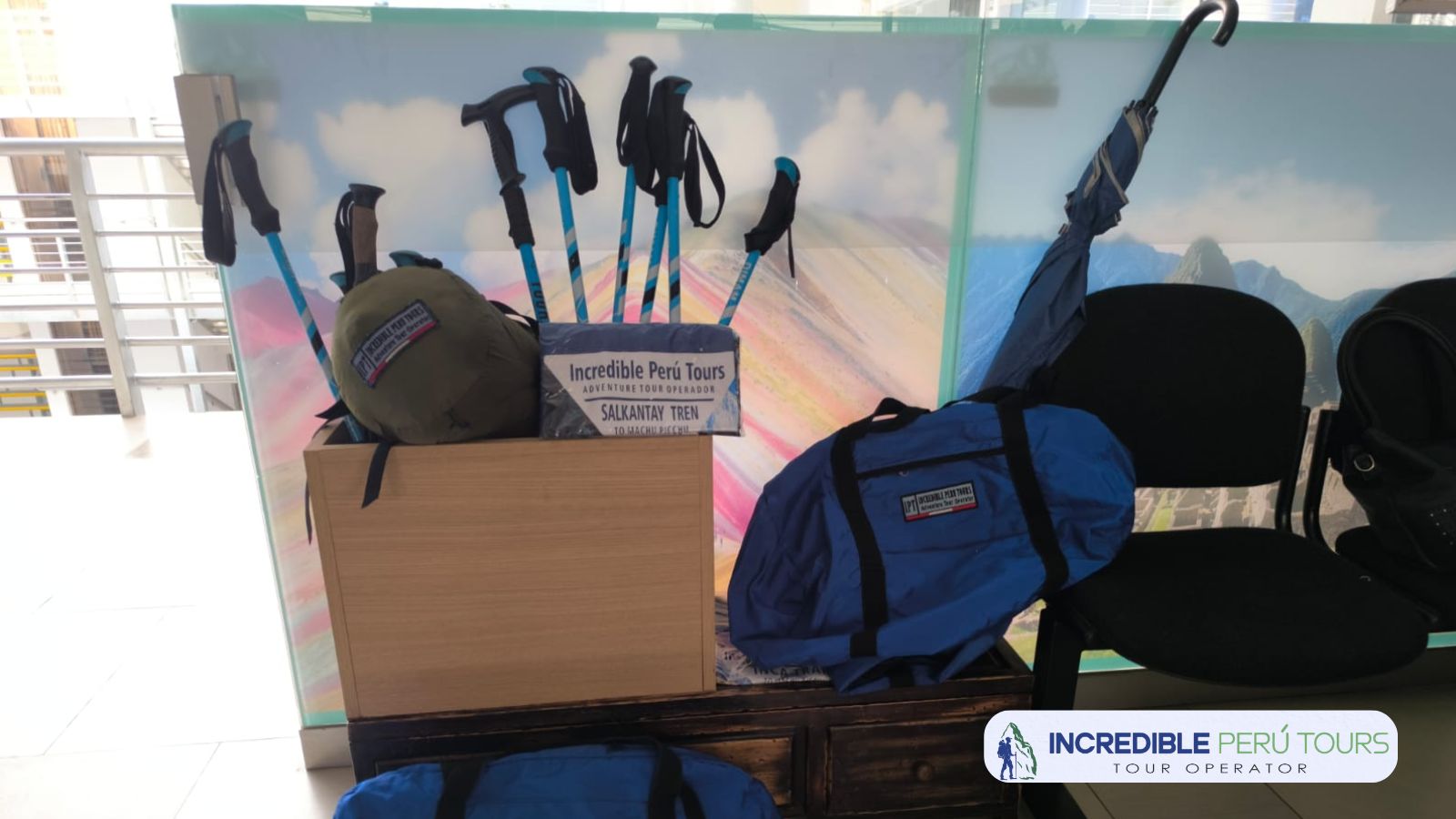
When you start preparing for the Salkantay Trek, you probably think first about your boots, backpack, or cold-weather clothing. However, there is one item that many travelers underestimate and that can be very useful during the hike: trekking poles.
The Salkantay Trek combines long climbs, stone paths, uneven terrain, and lengthy descents. On this type of route, poles can help you maintain better balance, distribute some of the effort between your arms and legs, and walk more safely on certain sections.
But are they really necessary? Is it better to bring one or two? How should they be adjusted? And which parts of the Salkantay Trek are they most useful for?
In this guide, you will find practical tips to decide whether you should bring trekking poles and learn how to use them correctly on your adventure to Machu Picchu.
Are trekking poles necessary for the Salkantay Trek?
They are not mandatory, but they are highly recommended for most travelers.
Some experienced mountain hikers complete the route without using them. However, for those who are not used to walking for several consecutive days on terrain with steep elevation changes, poles can provide comfort and stability.
They are especially useful for:
- Maintaining balance on uneven terrain.
- Getting extra support during climbs.
- Controlling descents more effectively.
- Reducing some of the strain on your legs.
- Walking more steadily when the ground is wet.
- Feeling more secure on rocky paths or loose dirt.
If this is your first multi-day hike in the Andes, you will probably appreciate having them.
Why are they useful on the Salkantay Trek?
One of the main characteristics of this route is its constant changes in altitude.
During the hike, you can go from high, cold areas near the snow-capped Salkantay mountain to warmer sections of cloud forest and high jungle.
This means that the terrain also changes constantly.
At some points, you will walk on relatively comfortable trails, while at others you will encounter steep slopes, rocks, mud, or narrow paths.
Trekking poles provide two additional points of contact with the ground, helping you maintain a more stable posture.
Trekking poles for Salkantay Trek ascents
During climbs, trekking poles can help you distribute your effort more efficiently.
Instead of relying only on your legs, you can also use your arms to propel yourself forward.
This is especially useful on days with a long ascent.
To use trekking poles during an ascent:
- Shorten them slightly.
- Place them in front of or slightly behind your body.
- Push gently with your arms as you move forward.
- Keep a steady pace.
- Avoid making movements that are too wide.
The idea is not to put all your weight on the poles, but to use them as extra support.
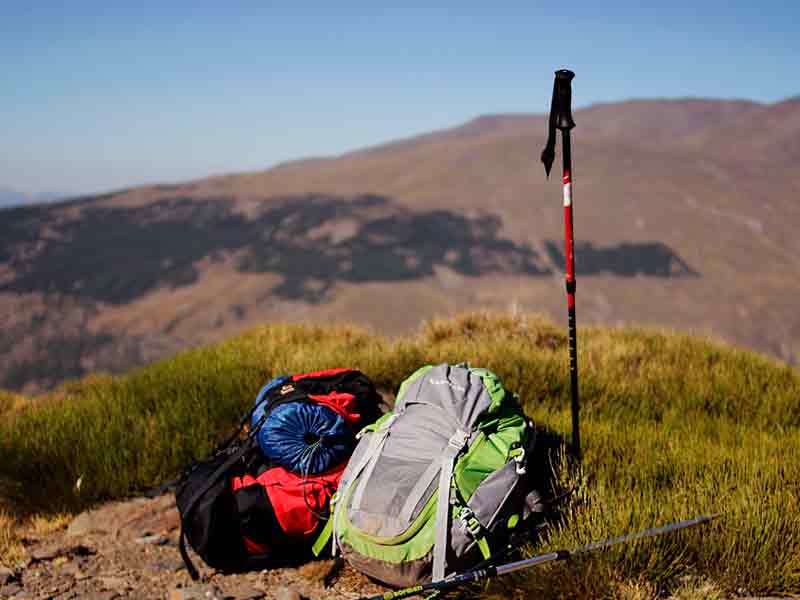
Trekking poles for descents
Descents are probably when you will appreciate having trekking poles the most.
After reaching the high sections of the route, long descents begin, where your legs work constantly to control every step.
Trekking poles can help you maintain balance and control your speed more effectively.
To go downhill:
- Lengthen the poles slightly.
- Place them in front of your body.
- Plant them before taking the next step.
- Go down with short steps.
- Avoid running or jumping.
- Keep your knees slightly bent.
On steep slopes, use the poles as support points before moving your feet.
One or two trekking poles?
For a route like the Salkantay Trek, two poles are usually more useful than one.
Using one pole can provide stability, but two allow you to distribute the effort more evenly across both sides of your body.
With two poles, it is also easier to maintain a natural rhythm during long hikes.
However, if you are not used to using them, it is advisable to practice before your trip.
How to properly adjust trekking pole height
The correct height is essential.
When standing on flat ground and holding the pole with its tip resting on the ground, your arm should form approximately a right angle.
You do not need to measure it exactly.
The important thing is that the pole is not so high that it raises your shoulders too much, or so low that you have to lean your body forward.
On flat terrain
Use a comfortable length that allows you to keep your arms relaxed.
Uphill
Shorten the poles slightly.
This makes it easier to use them when the terrain is above your feet.
Downhill
You can lengthen them a little.
This way, you can place the poles in front of you without having to lean your body excessively.
How to use the straps correctly
Many trekking poles include a small strap on the grip.
It is not there only to prevent you from losing the pole.
When used correctly, it allows you to distribute some of the effort onto your wrist.
A simple technique is to insert your hand through the strap from below and upward, then hold the grip.
This way, you do not need to squeeze the handle tightly all the time.
Avoid holding the poles with too much tension.
Your hands and arms should remain relatively relaxed while you walk.
How to walk with trekking poles without getting tired
One of the most common mistakes among beginners is trying to think too much about every movement.
On relatively flat terrain, try a natural movement:
right foot + left pole
left foot + right pole
It is similar to the natural movement of your arms when walking.
After a few minutes, it should feel automatic.
On steep slopes, the rhythm may change, and you can plant both poles before moving forward.
Which parts of the Salkantay Trek are they most useful for?
Although they can be used during almost the entire hike, there are certain types of terrain where they provide greater benefits.
High-altitude trails
The areas near Salkantay Pass can have rocky and uneven terrain.
Trekking poles provide additional points of stability.
Long descents
After reaching the trek’s high points, significant descents begin.
Here, they can be especially useful for controlling every step.
Muddy trails
During the rainy season, some sections may have mud or slippery surfaces.
A pole allows you to check the stability of the ground before fully placing your foot down.
Small water crossings
At certain points, you may find small streams or wet surfaces.
Trekking poles can help you maintain your balance as you move forward.
What type of trekking poles should you choose for the Salkantay Trek?
You do not need to buy the most expensive poles on the market.
For most travelers, the most important thing is that they are comfortable, adjustable, and durable.
Telescopic poles
They can be lengthened or shortened depending on the terrain.
They are a very practical option for the Salkantay Trek.
Folding poles
They take up little space and are easy to store in your backpack when you do not need them.
Aluminum poles
They are usually durable and offer a good balance between weight and durability.
Carbon fiber poles
They are very lightweight, although they generally come at a higher price.
For an occasional traveler, a good pair of aluminum poles is usually enough.
What type of tip should you use?
Many trekking poles include different accessories at the bottom.
Metal tips provide good grip on dirt and natural surfaces.
Rubber tip protectors can be used on hard surfaces or in certain areas where you want to reduce noise and impact.
Also check your guide’s instructions, especially when crossing areas where protecting the trail is important.
Can I rent trekking poles for the Salkantay Trek?
Yes, depending on the agency and the service you book.
Some agencies offer poles as part of the equipment, while others rent them for an additional cost.
Before buying a pair exclusively for your trip, ask what your package includes.
You can ask:
- Whether they are included.
- How much the rental costs.
- What type of poles they offer.
- Whether they are adjustable.
- Whether you need to reserve them in advance.
This can help you avoid carrying extra gear during your international trip.
Can you take trekking poles on a plane?
Policies depend on each airline and airport.
In many cases, trekking poles may be restricted in carry-on luggage because of their tips.
Therefore, if you travel with your own poles, check your airline’s rules before your flight.
Folding or telescopic models are easier to pack inside checked luggage.
Common mistakes when using trekking poles
Having good trekking poles is not very helpful if you use them incorrectly.
These are some common mistakes:
Using them too long
This can cause an uncomfortable posture and raise your shoulders too much.
Gripping them too tightly
You do not need to keep your hands completely tense for hours.
A relaxed grip is usually more comfortable.
Waiting until you are tired to use them
If you know you are about to start a long descent, it may be better to take out your poles from the beginning.
Placing them too far from your body
Exaggerated movements can make you lose energy.
Keep your support points relatively close.
Not practicing before your trip
If you have never used trekking poles, try them on a few hikes before traveling to Peru.
After a little practice, the movement becomes much more natural.
Do trekking poles help if I carry a backpack?
Yes.
The more weight you carry, the more important it is to maintain a stable posture while hiking.
However, remember that on the Salkantay Trek it is also important to avoid carrying an overly heavy backpack.
Trekking poles are helpful, but they do not replace good packing organization.
For daytime hiking, try to carry only essential items such as water, sun protection, waterproof clothing, documents, a camera, and a few personal items.
Are they recommended for beginners?
Yes.
In fact, travelers with little trekking experience may be the ones who benefit from them the most.
The main requirement is learning how to use them correctly.
You do not need to master a complicated technique. Simply practice on a few hikes before your trip and learn to adjust the length according to the terrain.
Should you train with trekking poles before the Salkantay Trek?
If you are going to use them during the trek, yes.
Take a few hikes close to home using the same poles you will use in Peru.
Practice especially:
- Uphill sections.
- Descents.
- Hiking on dirt trails.
- Length adjustments.
- Using the straps.
- Storing and taking them out quickly.
This will allow you to start the Salkantay Trek feeling more comfortable with your gear.
Trekking poles during the rainy season
During the rainiest months, some sections of the trail can become wet or slippery.
In these conditions, trekking poles can provide additional stability.
However, they should be used together with appropriate footwear.
Trekking poles do not replace hiking boots or trekking shoes with good soles and grip.
Is it worth bringing trekking poles on the Salkantay Trek?
For most travelers, yes.
They take up relatively little space, are lightweight, and can be used on numerous sections.
Their main advantage is not making the hike easy, but offering greater stability and support over several days of changing terrain.
If you are a beginner, carry a backpack, have little mountain hiking experience, or simply want to feel more stable on descents, they will probably be a great addition to your gear.
If you are preparing for your adventure, check out our Salkantay Trek to learn about the itinerary, included equipment, and recommendations before starting the route to Machu Picchu.
Frequently asked questions about trekking poles for the Salkantay Trek
Are trekking poles mandatory for the Salkantay Trek?
No. You can complete the route without them, but they are recommended for many travelers because of the climbs, descents, and uneven terrain you will encounter along the way.
Is it better to use one or two trekking poles?
Two trekking poles usually offer more balanced support and allow you to distribute your effort better during the hike.
Do trekking poles help during descents?
Yes. They are especially useful on descents because they provide extra support and help you control every step more effectively.
Can I rent trekking poles in Cusco?
Yes. There are agencies and shops offering trekking equipment rentals. Your tour may also include them or allow you to rent them.
Which material is best?
Aluminum poles are durable and suitable for most travelers. Carbon fiber models are lighter, but they are usually more expensive.
Should I practice before the trek?
It is recommended. A couple of hikes before your trip will allow you to get used to the movement, learn how to adjust the poles, and use them more naturally.
Can I store trekking poles when I do not need them?
Yes. Telescopic or folding models can be collapsed and attached to your backpack during sections where you prefer to walk without them.
Are trekking poles useful when it rains?
They can provide extra support when the terrain is wet or slippery, although they should always be used with suitable trekking footwear.