


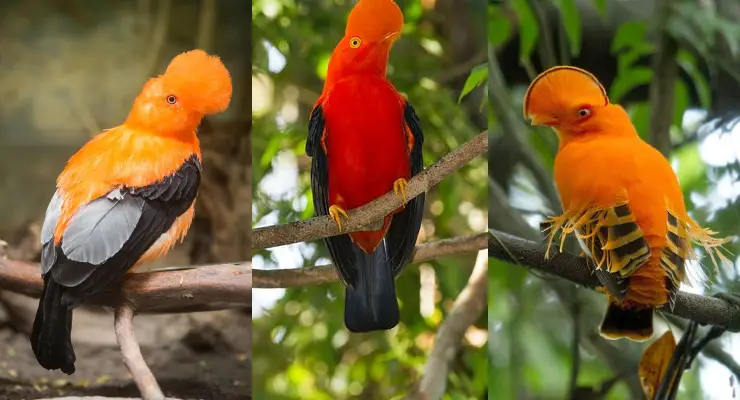
A flash of intense orange crosses the forest early in the morning, near the river, on the final stretch toward Aguas Calientes. It is the cock-of-the-rock, Peru’s national bird, and anyone who sees it never forgets it: a head crowned with a disk-shaped crest, brilliant orange plumage, and short flights between branches. It is the most spectacular of the many birds that inhabit this route, which crosses in five days from condor territory to the humid forests where hummingbirds and tanagers live.
Why the Salkantay is a great route for birdwatching
Peru is one of the countries with the most bird species in the world, and this route crosses three very different environments in just a few days: high-altitude puna grasslands, cloud forest, and high jungle. Each zone has its own group of species, and the change is noticeable from one day to the next.
You do not need to be an expert. Just wake up a little earlier and walk quietly for the first few kilometers, and you will see far more than you expect.
Birds of the puna
The Andean condor
It is the most sought-after bird in the Andes and one of the largest flying birds in the world. It is recognized by its size, white neck feathers, and wing tips separated like fingers.
It flies by taking advantage of warm air currents rising along the slopes, so the best time to look for it is mid-morning, when the sun has already warmed the rock faces. Look up around the mountain pass and on the slopes near the snow-capped peak. A sighting is not guaranteed, but it does happen.
High-altitude birds of prey
More common than the condor are hawks and caracaras that patrol the high plains. They are often seen perched on rocks or gliding low over the ichu grass, searching for rodents.
Birds of streams and wetlands
In the wet areas near Soraypampa, small, subtly colored birds move among the rocks in the water, while ibis and Andean ducks can be seen feeding in the high-altitude wetlands.
The torrent duck lives in the fast-flowing rivers on the descent, specialized in swimming against rushing water. Seeing one is one of the rewards of walking attentively beside the riverbed.
Cloud forest birds
Hummingbirds
They are the family that surprises hikers the most on the descent. There are species adapted to high altitudes, including some large ones, as well as tiny metallic-colored birds that appear in any flowering bush.
To see them, look for flowering shrubs beside the trail and stand still for a minute. They will come on their own.
Tanagers and mixed flocks
In the humid forest, it is common for several species to move together in mixed flocks. For a few minutes, the forest seems empty, and then a group of small, colorful birds passes through the branches feeding, before silence returns.
If you notice that movement, stop. Those are the best birdwatching minutes of the day.
Woodpeckers, trogons, and guans
Woodpeckers reveal themselves by tapping on tree trunks. Trogons remain motionless on middle branches and go unnoticed until someone points them out. And the large, noisy guans can be heard at dawn from forest campsites.
The cock-of-the-rock
It is Peru’s national bird, also known by its Quechua name, tunki. The male has bright orange plumage and a crest that covers part of its beak; the female is much more discreet, with brownish tones.
It lives in the humid forests of the eastern slopes, and the Machu Picchu area is one of its territories. Males gather at fixed sites in the forest to display themselves with jumps and calls, especially at dawn and late in the afternoon.
The best stretches to try to spot it are the path alongside the railway toward Aguas Calientes and the forests around town, always early in the morning. If your guide knows a spot where they usually appear, listen to them: it is all about being in the right place at the right time.
Birds of the warm section
Between La Playa, Santa Teresa, and Hidroeléctrica, the landscape opens up and birds become easier to spot.
Flocks of parrots and parakeets are common, crossing the valley at dawn and dusk, noisy and fast-flying. In tall trees near the river, you may see hanging bag-shaped nests woven by local birds, dangling in clusters from the same branch.
You will also see kingfishers along the riverbed, swallows over the water, and birds of prey gliding above the coffee plantations.
Where and when to look
| Group | Where | Best time |
|---|---|---|
| Condors and birds of prey | Salkantay Pass and high slopes | Mid-morning |
| Stream birds | Soraypampa and ravines | Early morning |
| Hummingbirds | Flowering patches in the forest | All day |
| Mixed flocks | Chaullay and Collpapampa | Dawn |
| Cock-of-the-rock | Path to Aguas Calientes | Dawn and dusk |
| Parrots and parakeets | Santa Teresa Valley | Dawn and dusk |
What to bring for birdwatching
- Compact binoculars. They make the difference between seeing a silhouette and identifying a species.
- A field guide or identification app downloaded for offline use.
- Neutral-colored clothing, without bright orange or white.
- The patience to get up twenty minutes before the group.
One rule of responsible birdwatching: do not use bird call recordings to attract birds or approach nests. In busy areas, these practices alter species behavior.
The mammals and other wildlife along the route are covered in Salkantay Trek wildlife, while the vegetation where all these species live is covered in Salkantay Trek flora.
Frequently asked questions
Can you see condors on the Salkantay Trek?
It is possible, especially around the mountain pass and in mid-morning, when rising air currents form. It is not guaranteed: the destination with more frequent sightings in the region is Colca Canyon.
What is the best time of year for birdwatching on the route?
Bird activity is good all year round. During the wet months, there are more flowers and fruit, attracting hummingbirds and fruit-eating birds; in the dry season, visibility is better and trails are in better condition.
Do I need a birding guide?
It is not essential, but it greatly changes the experience. If it is your main interest, ask the agency whether they can assign you a guide knowledgeable about birdlife and whether they offer dawn departures.
Where am I most likely to see the cock-of-the-rock?
On the humid forest stretch near Aguas Calientes, early in the morning. Walk quietly and watch for orange movement among the vegetation.
Is a phone camera useful for photographing birds?
For most species, no: they are too far away or move too quickly. One trick that works is holding your phone against the binocular eyepiece, although getting results requires patience.