


After two days among snow-capped peaks and icy highlands, the Salkantay Trek descends into a completely different landscape. From La Playa onward, the route to Machu Picchu crosses slopes covered with coffee plantations, fruit trees, and coffee beans drying beside homes. This is coffee-growing country, where the families who work the land welcome travelers to their farms to show how a cup of coffee is produced, from plant to brew. It is one of the most authentic local experiences on the trek, and often the one travelers remember most when they return home.
Why coffee is part of the route
The final stretch of the Salkantay Trek enters La Convención Province, one of Peru’s most traditional coffee-growing regions. Its cloud forest valleys combine the altitude, humidity, and temperatures that Arabica coffee needs to grow slowly and develop its flavor.
Coffee from this region has earned recognition in national competitions in recent years, and much of the production comes from small family farms like those you pass along the route. These are not large plantations: they are plots of just a few hectares where coffee grows alongside bananas, avocados, and shade trees.
Where coffee appears on the Salkantay descent
The first coffee plantations appear as you descend from Collpapampa, when the route enters the Santa Teresa River valley. By the time you reach La Playa, coffee is already part of daily life: plants alongside the trail, beans drying in the sun on tarps, and sacks ready to be transported by road.
The coffee-growing heart of this section is Lucmabamba, where several family farms welcome groups. From there to Santa Teresa, coffee remains present on the hillsides, in local shops, and in the town’s cafés.
The farms of Lucmabamba
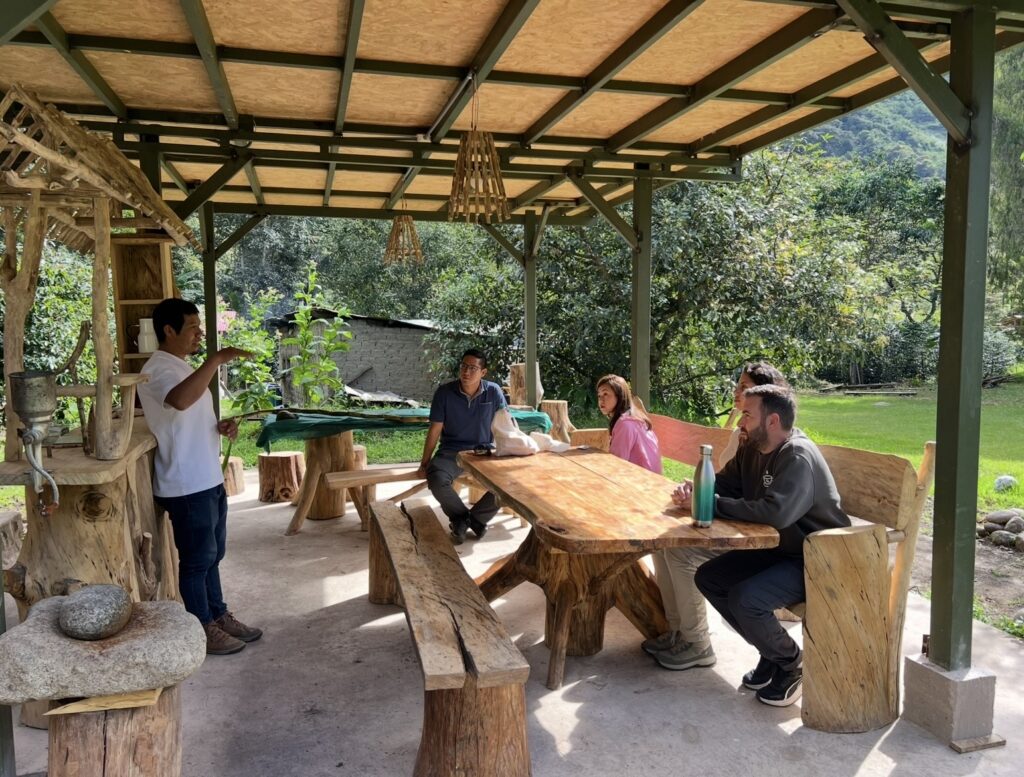
In Lucmabamba, coffee grows under the shade of fruit and native trees, a system that protects the plants from direct sunlight and preserves soil moisture. Families work their plots using traditional methods, and many process the beans right on the farm.
The visit is usually made on the afternoon the group arrives in the area or the following morning, before the ascent to Llactapata. It lasts around an hour and is led by the producer or a family member, with support from the trek guide for translation.
What you will see during a farm visit
The plant and the harvest
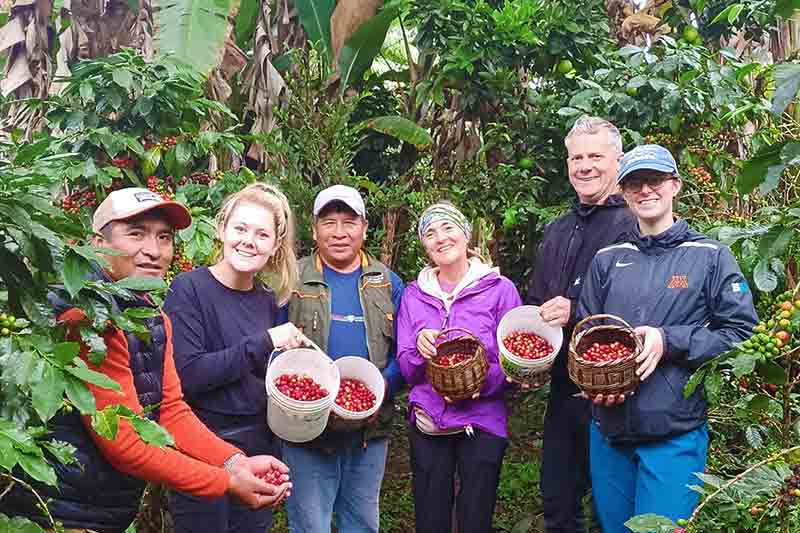
The tour begins among the plants. You will see the coffee fruit, a cherry that changes from green to deep red as it ripens. Harvesting is done by hand and selectively: only ripe cherries are picked, and each plant is checked several times throughout the season.
Pulping, fermentation, and drying
After harvesting, the coffee cherry is pulped to separate the bean. The bean is fermented in water to remove the sticky layer that covers it, then washed and spread out in the sun to dry for several days. This process determines much of the final flavor, and each family has its own timing and methods.
Roasting in a clay pot
This is the most eye-catching part of the visit. On many farms, the beans are roasted over a fire in a tiesto, a clay pot, stirring them constantly with a wooden paddle until they change color and begin to crackle. The aroma fills the kitchen within minutes.
Grinding and the cup
The freshly roasted beans are ground by hand and brewed in the same home. You finish the visit with a cup of coffee made from beans you saw growing on the plant an hour earlier. Some farms also offer an infusion made from the dried coffee cherry husk.
The best time to see the harvest
The harvest in this area is concentrated roughly between April and September, largely coinciding with the trek’s dry season. During these months, you will see ripe cherries on the plants, beans drying outside homes, and activity on every farm.
Outside the harvest season, visits still take place, but with beans stored from the previous season. You can still watch the roasting and taste a cup, although the plants will be flowering or have green fruit.
Coffee in La Playa and Santa Teresa
If your itinerary does not pass through Lucmabamba or does not include a farm visit, local coffee is still within reach. In La Playa, some families sell roasted coffee from their homes or in the town’s small shops.
In Santa Teresa, you will find cafés serving coffee from the province as well as shops selling it in bags of different sizes. It is a great place to try several preparations and compare them before buying.
How to buy coffee from the producer
Buying at the farm puts the money directly into the hands of the grower. Here are a few tips to make your purchase work well during the trek:
- Ask for whole-bean coffee if you have a grinder at home. It retains its flavor much longer than ground coffee.
- Ask for the roasting date. The more recent it is, the better.
- Keep the weight in mind. You still have days of hiking ahead, so buy amounts you can carry or that fit in the bag carried by the mules.
- Bring cash in soles and small bills. Farm purchases cannot be paid for by card.
- If you are flying back to your country, check food import regulations. Roasted and packaged coffee is usually allowed, but it is best to confirm.
How to include the visit in your itinerary
Not all Salkantay Trek variations pass through Lucmabamba. A farm visit is usually part of five-day itineraries that climb to Llactapata before descending to Hidroeléctrica. Shorter versions, which go directly from La Playa to Santa Teresa by vehicle, sometimes leave it out.
If you are interested in the coffee experience, ask when booking: whether the visit is included, what time of day it takes place, and whether it has an additional cost. It is easy to arrange when requested in advance.
To learn more about the families and villages in this section, see villages and communities along the Salkantay Trek route.
Frequently asked questions
Is the coffee farm visit included in the Salkantay Trek?
It depends on the agency and the trek variation. It is included in many five-day itineraries, while others offer it as an optional activity. Confirm when booking.
How long does a coffee farm visit last?
Around one hour, from the walk among the plants to the final tasting. It is a short stop that fits easily into the third or fourth day’s schedule.
Can I take part in the harvest?
During harvest season, some families invite visitors to pick cherries for a few minutes as part of the visit. It is not an organized activity at every farm, so ask your guide.
What type of coffee is grown along the Salkantay route?
Arabica coffee, grown under shade on family farms. Varieties vary from one farm to another, and the producer will usually explain which ones they grow during the visit.
Where can I buy coffee if I do not visit a farm?
In the small shops of La Playa and in the cafés and stores of Santa Teresa. You will also find coffee from the region in Aguas Calientes and Cusco, although buying it along the route allows you to purchase directly from the producer.