


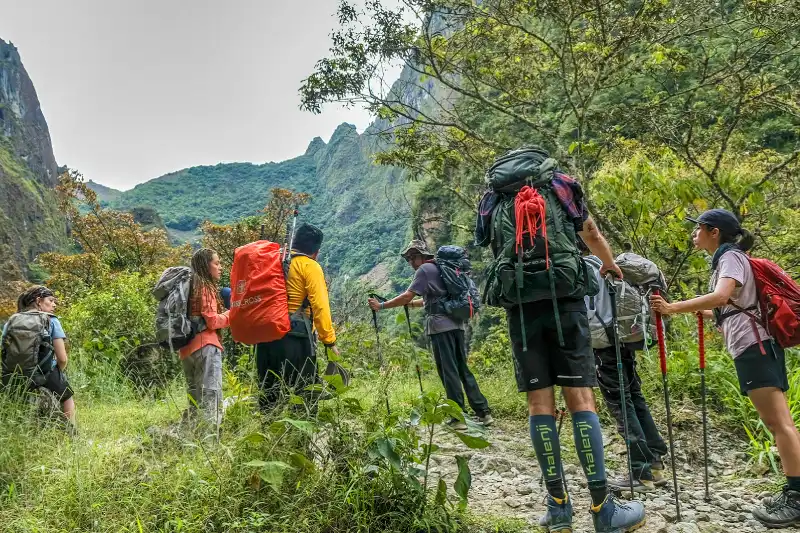
In five days of trekking, you go from 4 600 m a.s.l. at the mountain pass to 2 000 m a.s.l. in Aguas Calientes. That descent of more than two and a half vertical kilometers is equivalent, in terms of vegetation, to traveling thousands of kilometers in latitude. You start where only tough grasses and ground-hugging plants survive, and finish among orchids, giant ferns, and shade-grown coffee plantations. Few routes in the world pack so many ecosystems into such a short distance, and recognizing what grows along each section completely changes what you see.
The route’s ecological zones
Vegetation changes according to altitude, humidity, and sun exposure. Along the Salkantay, three distinct belts can be clearly identified.
| Zone | Approximate altitude | Dominant vegetation |
|---|---|---|
| Puna and snow zone | 4 000 to 4 600 m a.s.l. | Tough grasses, cushion plants, mosses |
| Andean forest | 2 800 to 4 000 m a.s.l. | Queñua trees, shrubs, bromeliads |
| Cloud forest | 1 800 to 2 800 m a.s.l. | Ferns, orchids, shade trees, and crops |
The puna: plants that withstand frost
Around Soraypampa and on the ascent to the mountain pass, vegetation may seem sparse at first glance. In fact, it is perfectly adapted to one of the harshest environments in the Andes: below-freezing nighttime temperatures, intense solar radiation, and constant wind.
Ichu grass
This is the yellowish grass that covers the puna slopes and forms dense clumps. Its structure protects the roots from frost and retains moisture. For local families, it serves as livestock fodder, roofing material, and fuel.
Cushion plants
These are the hard, green cushions that grow close to the ground and rocks near the mountain pass. They grow very little each year, and some of those you see may be decades old. While walking, avoid stepping on them: they take an extremely long time to recover.
Mosses and lichens
They cover stones in the damp areas near snowmelt, forming green, gray, or orange patches. They are among the first organisms to colonize the ground exposed by retreating ice.
The queñua, the highest-growing tree
On the descent from the mountain pass, in sheltered ravines, small twisted trees begin to appear, with reddish bark that peels away in thin, paper-like layers. This is the queñua, one of the highest-growing trees on the planet.
Its layered bark provides insulation against the cold. Its forests shelter high-altitude wildlife and retain water for the ravines, and they are among the Andean ecosystems most threatened by logging and grazing.
The cloud forest
Between Chaullay and Collpapampa, you enter the belt where mist gathers against the mountain almost every day. That constant moisture explains what you see: everything is covered in something else.
Bromeliads
They grow on tree branches, with leaves arranged in a rosette that collects rainwater in the center. They are not parasites: they use the tree only for support. These small pools of water are, in turn, home to tiny insects and amphibians.
Ferns and tree ferns
In the wettest areas, ferns of every size appear, including tree ferns with a fibrous trunk and a crown of fronds at the top. They are an ancient group of plants and give this section its primeval forest feel.
Hanging mosses
They hang from branches in green and gray curtains. Their presence indicates clean air and constant humidity, two conditions found year-round in this belt.
Orchids and begonias
Peru is one of the countries with the greatest orchid diversity in the world, and the Machu Picchu region is especially rich. Many of those growing here are tiny: flowers just a few millimeters wide on trunks and branches, easily overlooked unless you stop to look.
Blooming is concentrated in the wet months and the weeks that follow, so hikers traveling between November and April see far more than those visiting during the heart of the dry winter.
Alongside them are wild begonias with pink and white flowers in the shaded sections of the trail, and hanging fuchsias with red tubular flowers near the ravines.
Look, take photos, and do not pick them. Wild orchids do not survive away from their host tree, and removing them is prohibited.
Plants with traditional uses
Much of the vegetation you pass has everyday uses in the communities along the route.
Muña, an aromatic shrub similar to mint, is used as an infusion and grows in the highlands. Coca, cultivated in the warm valleys, accompanies work and rituals. Eucalyptus, introduced from abroad more than a century ago, appears on slopes near villages and is used as firewood and in infusions for colds.
If you are interested in the cultural side of these plants, we cover it in payment to the earth on the Salkantay Trek.
Crops along the final section
From La Playa to Hidroeléctrica, wild vegetation blends with cultivated plants. Coffee grows under the shade of fruit trees, while bananas, papayas, citrus fruits, and avocados grow around homes.
This shade-grown farming system maintains tree cover and allows much of the forest’s wildlife to remain present among the fields. Learn what is produced and in which season in fruits and local products of the cloud forest.
How to observe without causing harm
- Always walk on the marked trail. Shortcuts erode the slopes and destroy vegetation that grows extremely slowly.
- Do not pull up flowers, orchids, or mosses, even to photograph them better.
- Do not collect seeds or plants to take home: taking them out of the country is regulated.
- Take all your trash with you, including fruit peels, which can take months to decompose at high altitude.
- If you camp, do so only in designated areas.
Frequently asked questions
What time of year are there more flowers on the Salkantay?
Between November and April, during and after the rains, when the cloud forest is at its greenest and orchids and begonias bloom. During the dry season, the landscape is clearer but there is less flowering.
Can I take an orchid or seeds with me?
No. Removing wild plants is prohibited, and taking them out of the country is regulated. In addition, orchids from this area do not survive outside their environment.
What is ichu?
It is the tough, yellowish grass typical of the Andean puna. It covers the slopes in the upper part of the route and is used as fodder, roofing material, and fuel.
Are there dangerous plants along the route?
There are no aggressive species on the trail, but in the high jungle area it is best not to touch unfamiliar plants: some have thorns or irritating sap. Simply stay on the trail and do not move vegetation aside with your hands.
Is it worth bringing a plant guide?
If you are interested in the subject, yes, although it adds weight. An alternative is to download an identification app that works offline, as there is no signal along much of the route.