


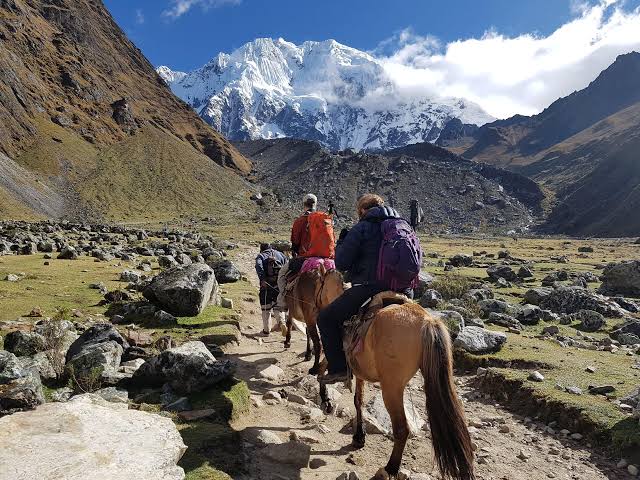
Yes, you can do part of the Salkantay Trek on horseback, but not the entire route. Horses are common in the high section of the trail, right where the hike is most demanding: the climb to Humantay Lake and the ascent to the pass, above 4 600 m s. n. m. For many people, having a horse on these sections is what makes the trek possible. But riding has its own rules and limitations, and it does not replace acclimatization or eliminate every risk. Here is where you can use one, how to book it, and what to keep in mind before getting on.
The short answer: yes, but not the entire route
Riding horses are mainly found between Soraypampa and Salkantay Pass, during the first two days. They belong to local muleteers, who know the terrain and lead the animal on foot throughout the journey.
From the descent toward the high jungle onward, riding horses are uncommon. The trail changes, road sections appear, and the day is less demanding on your legs, although it is longer.
Sections where you can ride a horse
Climb to Humantay Lake
This is the first demanding section of the trek: a short but steep climb from Soraypampa to the lake, at around 4 200 m s. n. m. Horses cover much of the route, but the final stretch, closest to the lake, is usually done on foot.
The descent is usually done walking. It is quick, and the slope makes riding down uncomfortable.
From Soraypampa to Salkantay Pass
This is the section where horses are used the most and appreciated the most. It involves several hours of steady uphill walking, with sharp switchbacks and increasingly thin air. The horse can take you to the pass or to an intermediate point, depending on what you arrange with the muleteer.
The descent from the pass
The initial descent from the pass is steep and covered with loose stones. On this section, many muleteers and guides recommend getting off and walking down, even if you rode up. Further down, when the trail becomes gentler, some travelers ride again until the lunch stop.
Why not in the high jungle
From Chaullay and Collpapampa onward, riding horses are scarce. Demand drops because the terrain is gentler and because the route already has vehicle access on several sections. If someone cannot continue walking in that area, the usual solution is transportation, not a horse.

Three ways to have a horse
The group’s support horse
Many agencies bring a support horse with the group on the day of the pass. It is not assigned to anyone: it is for anyone who has a health problem or cannot continue. You should not count on it as planned transportation, because if someone else needs it, they have priority.
A horse booked by section
If you already know you want to ride uphill, request it when booking the trek. The agency arranges a muleteer and a horse exclusively for you on the sections you choose: Humantay, the pass, or both. It is the safest option because the animal is guaranteed.
A horse hired along the way
In Soraypampa and at the base of Humantay, there are usually muleteers offering horses to travelers who decide at the last minute. It is useful if you feel worse than expected, but during high season there may not always be animals available, and the on-site price is usually higher than the one agreed in advance.
What are the limitations of riding a horse?
Rider weight and experience
The local horses are small and hardy, adapted to the altitude, but they have a limit. Some muleteers set a maximum rider weight. If you are close to the limit, mention it when booking so they can assign a suitable animal.
You do not need riding experience. The horse walks at a steady pace, and the muleteer leads it on foot at all times. Horses never gallop.
You still feel the altitude
Riding a horse reduces physical effort, but it does not protect you from altitude sickness. The pass rises above 4 600 m s. n. m. for everyone, whether walking or riding. You need the same number of acclimatization days in Cusco before setting out.
Colder while riding
When walking, your body generates heat. While riding, you barely move, and on the climb to the pass, the wind and low temperatures feel much stronger. Bring gloves, a hat, and an extra warm layer within reach, and put on your jacket before riding up.
Weather and trail conditions
With ice on the trail, heavy rain, or recent snowfall, muleteers may decide not to take riders through the most exposed sections. It is a safety decision for both you and the animal. In those cases, you will have to walk those sections or wait for conditions to improve.
Horses in emergencies
In the high section, a horse is the fastest way to move someone who cannot continue. The pass section has no vehicle access, so if a traveler develops severe altitude symptoms or an injury, the guide coordinates with the muleteers to bring them down on horseback.
Before the pass, the descent goes back toward Soraypampa, where the road from Mollepata arrives. After the pass, it goes toward the Chaullay and Collpapampa area, where the route has vehicle access again. From these points, transport to a health center is arranged. We explain what medical care is available on each section in the services available during the Salkantay Trek.

How to ride safely on the trail
- Always follow the muleteer’s instructions, as they know the animal and the terrain.
- On uphill sections, lean your body slightly forward. On descents, lean back.
- Hold on to the saddle, not the reins, which are handled by the muleteer.
- Carry a light, well-fitted daypack so you do not lose your balance.
- Do not use your phone or camera on narrow or steep sections.
- If you feel unsafe on any section, ask to get off and walk it. This is very common, and nobody will question it.
Also check whether your travel insurance covers horseback riding. Some policies consider it a risky activity and exclude it unless you purchase additional coverage.
Who should consider a horse
Booking a horse for the day of the pass is a sensible decision if you walk slowly, have knee discomfort, travel with older people, or simply want to reach the pass with enough energy to enjoy it. It is not cheating: it is an option that has always existed on the route and that many travelers use every day.
If your only concern is the weight of your backpack, you do not need a riding horse: you simply need to organize what you send with the mules properly. We explain this in luggage transport on the Salkantay Trek.
Frequently asked questions
Can you do the entire Salkantay Trek on horseback?
No. Riding horses are used in the high section, on the climb to Humantay and to the pass. On the initial descent from the pass and on the high-jungle section, the route is done on foot or, on some sections, by vehicle.
Is the horse included in the tour price?
The emergency support horse is usually included. A horse reserved for riding a section is almost always paid separately. Ask when booking.
Can children ride horses?
Yes, always with the muleteer leading the animal and on the sections they consider safe. Arrange it with the agency before departure so they can assign a calm horse.
Does riding a horse prevent altitude sickness?
No. It reduces exertion, but the altitude is the same. You still need to acclimatize in Cusco just as you would if walking.
What happens if I book a horse and then feel well enough to walk?
You can walk and use the horse only if you need it. Many people book one as a backup and use it on the final section of the climb. The payment usually remains the same because the muleteer and animal were available for you.