


There is one animal you will definitely see every day, several times: the mule. They trot along the side of the trail carrying bags, tents, and food, led by the muleteer walking behind them. They are your first and most constant encounter with wildlife along the route. From there, everything you see depends on the time of day, the section of the trek, and how quiet your group is. The route crosses the territory of vizcachas, foxes, and bears, although each reveals itself in a very different way.
How easy is it to see wildlife on the Salkantay Trek?
It is worth setting realistic expectations. This is not a safari route: groups are numerous, the trail is busy, and most wild mammals avoid people.
What does work is hiking at the edges of the day, at sunrise or late afternoon, when animals are active and there is less movement on the trail. Walking a little apart from the group, without music or conversation, greatly increases your chances.
This article does not include birds, which deserve a separate chapter because of their variety and interest. You can find them in birds of the Salkantay Trek.
Animals of the puna
The vizcacha
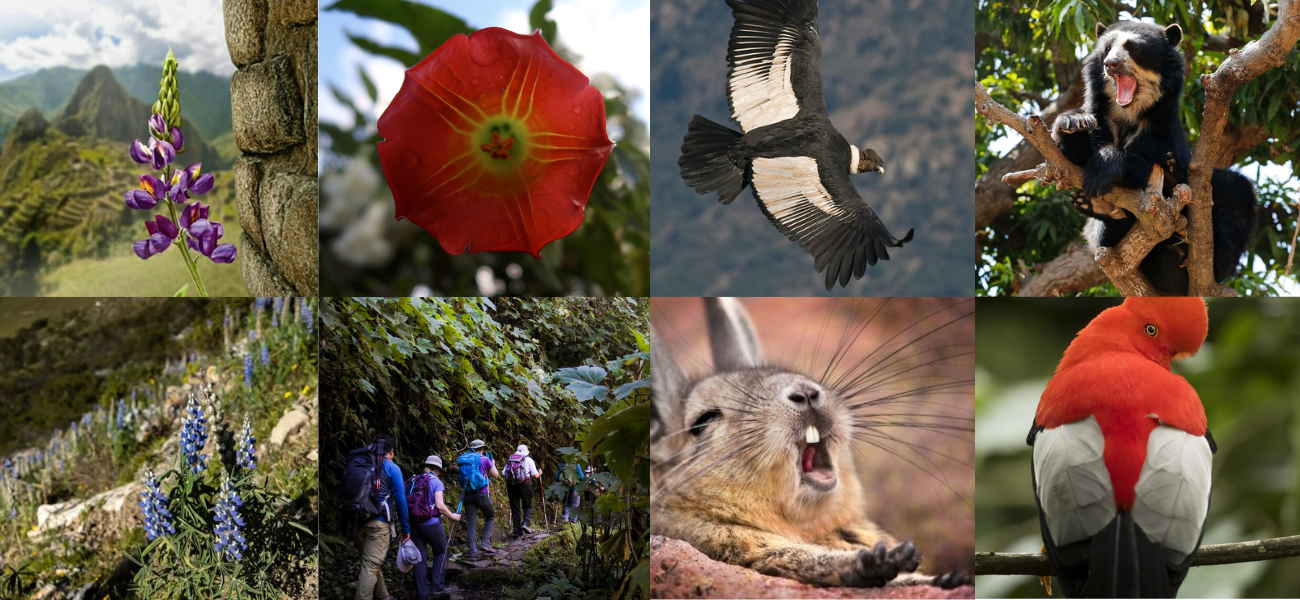
It is the easiest wild animal to spot in the high-altitude section. It looks like a large rabbit with a long tail and gray fur, and it lives in colonies among the rocks.
It likes to bask on rocks early in the morning and late in the afternoon, and those are the times when you may spot it sitting still, watching people pass by. Look for areas of loose rocks near Soraypampa and on the climb to the pass.
The Andean fox
More elusive, but present throughout the highland area. It is about the size of a medium-sized dog, with reddish-gray fur and a thick tail. It is mainly seen crossing distant slopes, almost always early in the morning.
It approaches camps at night looking for food scraps, which is a good reason not to leave waste outside your tent.
Llamas and alpacas
They are not wild: they belong to local families and graze freely in the high-altitude plains. You will see them near Soraypampa and on the slopes along the path to the pass.
You can photograph them from a distance without a problem, but do not touch them or try to get close for a photo: they are working animals and belong to someone.
Cloud forest mammals
The spectacled bear
It is South America’s only bear and lives in the cloud forests of this region, including the Machu Picchu area. It gets its name from the light markings around its eyes.
Seeing one is rare and would be a considerable stroke of luck. It is solitary, moves through dense vegetation, and avoids people. What you may find sometimes are signs: broken branches, remains of eaten bromeliads, or tracks in the mud. It feeds mainly on plants and fruit and poses no danger to hikers.
Other mammals
Opossums, weasels, and small rodents live in the forest, almost all with nocturnal habits. You are more likely to hear them moving through the vegetation at dusk than to see them.
The puma also lives in the region, in highland and forest areas, but it is extremely elusive. Encounters with hikers are exceptional.
Small life in the high jungle
On the stretch between La Playa and Aguas Calientes, wildlife changes scale: what is interesting is no longer on distant slopes, but just a meter from your feet.
Butterflies
They are the most visible wildlife on this section. They come in all sizes and colors, and on sunny days they gather in groups on the damp sand along the banks to absorb minerals. Among them, metallic blue-winged butterflies stand out, visible in flight through clearings in the forest.
Amphibians and reptiles
Cloud forest frogs are heard more often than seen, especially after rain and at dusk. Lizards, on the other hand, are easy to spot basking on rocks and trail walls.
Snakes exist in the lower section, but encounters are infrequent and they almost always flee. The rule is simple: do not put your hands between rocks or logs, and watch where you step when leaving the trail.
Insects
Beetles, dragonflies, ants, and fireflies are part of the nighttime landscape in the warm section. Biting insects, and how to avoid them, are covered in mosquitoes on the Salkantay Trek.
Working animals and animals around homes
Mules and pack horses are part of the route’s daily operation. You will also see cows, sheep, dogs from local homes, and chickens in the small settlements along the way.
There is one safety rule worth learning on the first day: when a mule train passes through a narrow section, step aside toward the mountain side, never toward the edge of the cliff. A loaded mule takes up more room than it seems and will not move aside.
If a camp dog follows you during the hike, do not feed it. It may end up following the group for miles and straying far from home.
How to observe without disturbing
- Do not feed any wild animal, not even fruit.
- Observe from a distance and do not chase an animal to get a photo.
- Keep food and trash inside the tent at night.
- Speak quietly in forest sections if you want to see anything.
- A small pair of binoculars is worth its weight on this trek.
- Ask your guide: they know the spots where vizcachas and foxes usually appear.
Frequently asked questions
Are there dangerous animals on the Salkantay Trek?
Not for a hiker who stays on the trail. Large mammals avoid people and snakes flee. The most common problems are insect bites and, occasionally, dogs from local homes barking as you pass.
Will I see a spectacled bear?
It is very unlikely. It lives in the area, but it is solitary and elusive. The most common thing is to find signs of its presence in the forest, if someone knows how to recognize them.
Where can you see vizcachas?
Among the rocks in the high-altitude section, near Soraypampa and on the climb to the pass. At sunrise and sunset, they come out to bask on the rocks.
Can I get close to llamas and alpacas?
Photograph them from a distance and do not try to touch them or pose beside them without permission. They are working animals that belong to local families.
Is it worth bringing binoculars?
Yes, especially compact ones. In the high-altitude section, they let you follow foxes and vizcachas on distant slopes, while in the forest they help you make out what is moving through the vegetation.