


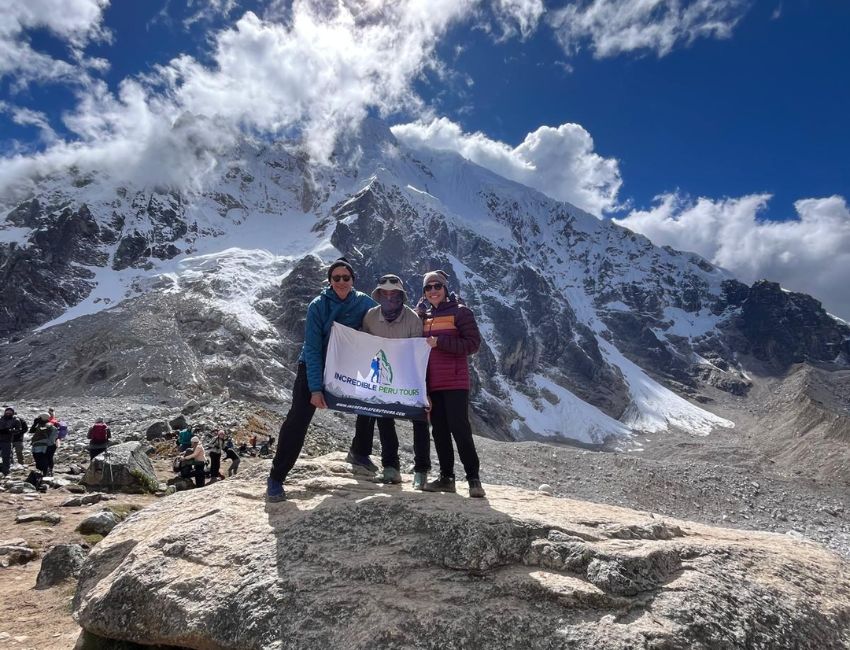
Two travelers book the same trek in the same week. One is twenty-six, traveling solo, and what excites him most is the people he will meet along the way; price matters a lot to him. The other is traveling with her parents, both in their late sixties, and knows they will walk slowly, need frequent breaks, and that her mother eats gluten-free. Both will cross the same mountain pass and sleep at the same campsites, but neither should book the same service. That is the whole difference between a group trek and a private one.
What each option is
With a group service, you share the trek with other travelers who booked independently. The agency puts the group together with the people registered for that date, and the itinerary, schedules, and pace are the same for everyone.
With a private service, the group includes only the people you are traveling with: you, your partner, your family, or your friends. The guide, cook, and team work exclusively for you, and you choose the departure date.
The route, campsites, and entry to Machu Picchu are the same in both cases. What changes is everything that happens around them.
The differences, point by point
| Aspect | Group | Private |
|---|---|---|
| Price per person | The lowest | Higher, but decreases with more people |
| Departure date | Fixed dates depending on availability | Whichever date you choose |
| Group size | Variable, up to the agency’s maximum | Only your group |
| Walking pace | The group’s pace | Your pace |
| Departure times | Set by the guide | Flexible each day |
| Guide attention | Shared among everyone | Exclusive |
| Guided tour language | The group’s language, sometimes bilingual | The language you request |
| Food and dietary needs | Standard menu with adaptations | Menu tailored to your group |
| Atmosphere | Meet people | Privacy |
The price and how it changes with group size
A private service does not have a fixed per-person price: it is calculated by dividing the cost of the guide, cook, muleteers, and transport among the participants, and that cost is practically the same whether there are two people or eight.
That is why a private trek for two people is considerably more expensive than a group trek, while one for six or eight comes much closer to the shared-service price. If you are traveling with friends or family, always request both quotes: the difference is often surprising.
What does not change between the two options is entry to Machu Picchu and the train, which cost the same in both cases. The remaining expenses are additional costs you should consider when booking a Salkantay Trek.
Pace: the difference you notice most
In a shared group, you walk at the group’s pace. The guide waits for the slowest hikers, sets the breaks, and establishes the departure time, which on the classic route is usually very early.
This works well when your pace is average. It becomes a problem if you walk much slower, because you feel like you are holding the group back, or much faster, because you spend the day waiting.
On a private trek, the day adapts to you: you can leave half an hour later, extend a stop at a viewpoint, take a long lunch break, or shorten a stage if someone is not feeling well.
Guide attention
In a large group, the guide divides their time and energy among everyone, and on demanding sections focuses mainly on those who need the most support.
On a private trek, guiding becomes a conversation. You can ask as much as you want about the mountains, communities, or plants along the trail, and the guide can stop to explain something that interests you without disrupting anyone else’s day.
Who guides you and what training they have is a separate criterion that applies to both options, and we explain it in how to choose a reliable agency for the Salkantay Trek.
The atmosphere: what you gain and what you miss
It is worth being clear: for many people, the group is part of the appeal of the Salkantay. You cross the mountain pass with strangers, share the afternoon tea table every day, and many people finish the trek with friendships that continue after the trip.
A private trek wins in peace and flexibility, but loses that part. If you are traveling solo and looking for company, a group trek is not a compromise for your budget: it is the option that gives you what you want.
Who each option works for
A group trek is best if
- You are traveling solo and want to meet people.
- You are on a tight budget.
- Your walking pace is average.
- Your dates match the scheduled departures.
- You do not have specific schedule or dietary needs.
A private trek is best if
- You are traveling with children, older adults, or someone who walks slowly.
- You are a family or group of friends, where the per-person price decreases.
- You want a specific date that is not on the departure calendar.
- It is a special trip, such as a honeymoon or anniversary.
- You are interested in photography or birdwatching and need to leave at sunrise and stop whenever you want.
- You have a strict diet or a medical condition that requires special attention.
Middle-ground options
Not everything is black and white. Several agencies offer small groups with a guaranteed maximum of six or eight people, which cost a little more than standard group treks while keeping the group atmosphere without the drawbacks of hiking with twenty people.
Another option is a private trek without extras: the same exclusive service, but with standard campsites and equipment instead of higher-category accommodations. It is the most affordable way to have your own guide.
What to ask before deciding
- What is the maximum number of travelers in the shared group, not the average?
- How much does a private trek cost for our exact number of people?
- Does the private trek include the same campsites, or do they change?
- Can we adjust departure times each day?
- Are guaranteed small-group departures available?
- If I book a group trek and the minimum number is not reached, what happens to my date?
Frequently asked questions
How much more does a private Salkantay Trek cost?
It depends on the number of participants. For two people, the difference is significant; for six or eight, it is greatly reduced because the cost of the team is shared. Always request both quotes for your exact number of people.
Is a private trek safer?
Safety depends on the agency, not the type of service: protocols, a certified guide, oxygen, and a first-aid kit should be included in both. What does improve on a private trek is individual attention if someone feels unwell.
Can I change from a group trek to a private trek after booking?
Many agencies allow it if you pay the difference, as long as there is enough time to reorganize the team. Ask as soon as possible, especially during high season.
Does the itinerary change on a private trek?
The route and overnight stops are usually the same. What can be adjusted are the schedules, pace, length of breaks, and, in some cases, the division of the stages.
I am traveling solo. Can I book a private trek?
Yes, but it is the most expensive arrangement because the full cost of the team falls on one person. For solo travelers, a group trek or a guaranteed small group is usually a better option.